David Oranchak’s Part 3 Deep Dive on Alex Baber — And One Historical Correction
June 2, 2026
Birch Bay, Washington
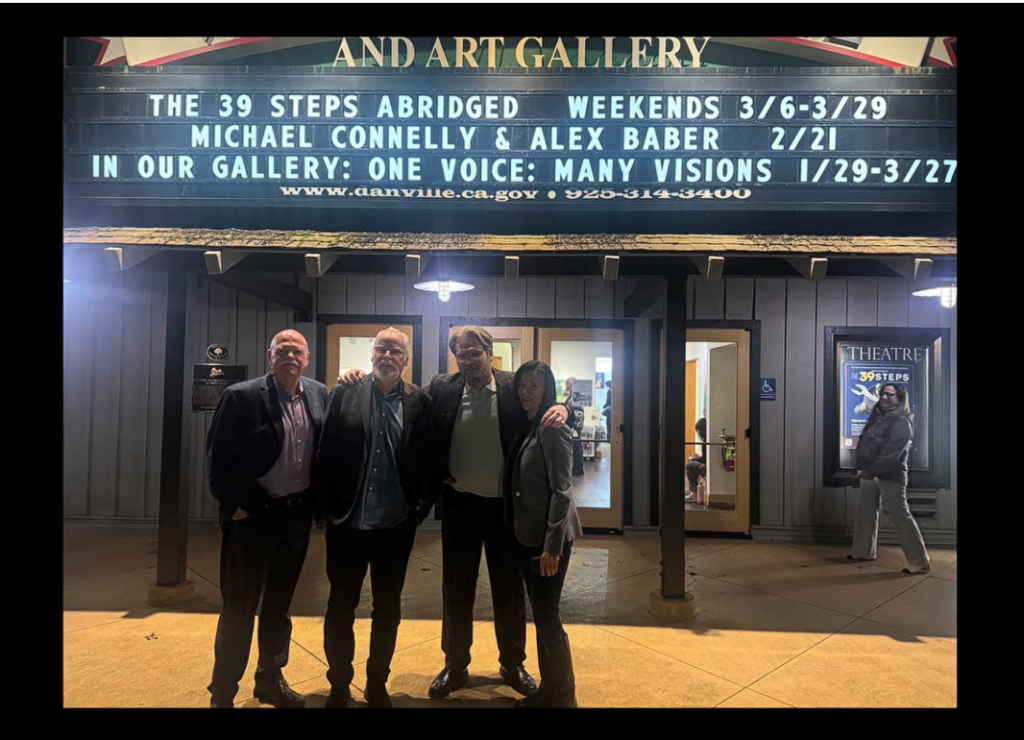
I just finished watching David Oranchak’s ninety-minute Part III presentation examining Alex Baber’s background, credentials, and public claims regarding the Zodiac and Black Dahlia cases. It is, in my opinion, an exceptional and deeply researched piece of investigative work.
Oranchak—best known for his role in the team credited with solving Zodiac’s Z340 cipher—carefully documents Baber’s history, on-camera statements, contradictions, and unsupported claims in a methodical and professional manner. Rather than relying on personal attacks, he lets Baber’s own words, public appearances, and documented record speak for themselves. The result is devastating, but also objective.
LAPD Cold Case detectives, and anyone seriously interested in the recent Zodiac/Black Dahlia crossover theories, should watch the presentation in full.
One aspect I particularly appreciated was Oranchak’s acknowledgment that I had openly shared my 2009 and 2015 Black Dahlia and Zodiac linkage research materials with Baber several years ago, believing at the time that he was operating in good faith in his statement that, “My supercomputer should be able to assist in what you have already established.”
That included my long-standing research linking the Black Dahlia murder to Zodiac-related crimes, including the Cheri Jo Bates homicide and the Manila bisection murder of Lucila Lalu in 1967.
Researchers often exchange information and theories. What matters is how that material is later represented and used.
That said, there was one comment in the presentation I feel deserves a polite historical correction.
While discussing author Michael Connelly and others who had previously given credibility to Baber’s work, Oranchak remarked that Connelly had once “backed the wrong horse” with Black Dahlia Avenger and Steve Hodel, referencing Connelly’s later public reconsideration of some of my conclusions.
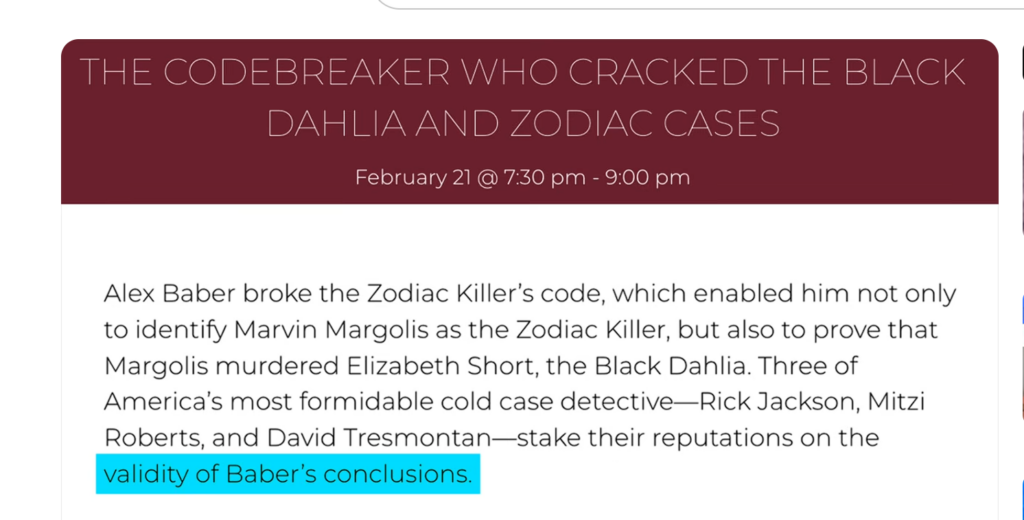
I respect Oranchak’s right to his opinion. However, I believe that comparison unintentionally conflates two very different situations.
Over more than two decades, my investigation into Dr. George Hodel and the Black Dahlia murder has been extensively scrutinized, debated, criticized, supported, challenged, and publicly examined. Critics have certainly disputed my conclusions. That is fair and expected in any major cold case investigation.
But no law enforcement agency has ever publicly discredited my investigation as fraudulent, fabricated, or unfounded.
To the contrary, during my 2003 in-person briefing—alongside then-Head Deputy District Attorney Stephen Kay—to LAPD brass and Cold Case detectives, former LAPD Chief of Detectives James McMurray, then the department’s number two-ranking officer, was sufficiently persuaded by my investigation that he instructed homicide detectives “to move forward and clear the 1947 Elizabeth “Black Dahlia” Short case based on Steve Hodel’s findings, absent the discovery of major holes in the evidence.
Detectives, including then-active Cold Case investigators Mitzi Roberts and Rick Jackson, ultimately declined—prior to their retirements—to pursue the matter further, citing workload and other priorities.
People are free to disagree with my conclusions regarding George Hodel. Reasonable investigators can and do disagree on unsolved cases. But controversial research is not the same thing as deceptive research, and disputed conclusions are not equivalent to fabricated claims.
That distinction matters.
None of this diminishes the importance of Oranchak’s work exposing the serious issues surrounding Alex Baber’s representations and theories. In fact, I believe his presentation performs a valuable service by insisting that evidence, documentation, and historical accuracy still matter in cold case research.
For that, he deserves considerable credit.
Steve Hodel
LAPD Det. III #11394
Hollywood Homicide (Ret.)
DAVID ORANCHAK’S PART 3 – BACKGROUNDING ALEX BABER (90 mins video)
Thanks for the link. I have yet to watch the video, but seeing the first few seconds gives me an idea who the man is. To want to be in the same league as a fictional detective – where the author holds all the evidence and not the real world – is not something to be associated with unless you are also writing fiction. I suspect that his ego has gotten the better of him, though I could be wrong. The answer will have to wait until I watch the entire video. It should be an interesting viewing.
I have encountered a similar type of arrogance in my own research into the controversial Shakespeare authorship question. Countless scholars and commentators routinely ignore or dismiss real evidence as worthless, cherry-picking what they need to support their theories.
That is why I said above that authors hold all the cards in fictional detective stories: they can create evidence on the fly. Real investigative work goes where the evidence leads: police and scientists cannot predict where that evidence will come from or how it will affect their theories.
Having read your four BDA and two zodiac books, I can safely say that you have followed where the evidence led you to, no matter how painful the outcome was. Careful readers will note a degree of honesty and doubt which few true crime writers express. In my opinion, that is what great researchers do. Sloppy researchers seem to never doubt their findings and steamroller over contrary evidence with impunity.
Ron:
Just received the Shakespeare book today. Unfortunately, the print is smaller than I had hoped for for these old eyes, but may have to scan for easier reading just take if one chapter at a time. If I recall the info in the Manley Hall “Big Book” he credited numerous noblemen of the day as authors of the Shakespeare Plays. I do recall that “Shakespeare fans” go apoplectic at the mere suggestion that the plays might have ben written by someone other that the Great Bard. I’m sure that has and likely will never change.
Hi Steve,
I feel that you will find his book an interesting read. Yes, there is little chance that Stratfordians will change their mind, even if a “smoking gun” is somehow found among some ancient family’s papers.
If there is one thing I can definitely say, it’s that your a good writer!