The Black Dahlia: “Case Solved”—Senior Law Enforcement Statements and the Sources Behind Them
October 29, 2026
Birch Bay, Washington
Over the years, I have published statements concerning the Black Dahlia investigation made by senior members of the Los Angeles Police Department, the Los Angeles County Sheriff’s Department, and the District Attorney’s Bureau of Investigation.
Here, I am bringing them together, each on an individual page identifying the official, his statement, and its source.
Who said these things matters. So does how their words reached us.
Some statements were made publicly in interviews or published accounts. Others were private remarks later reported to me by individuals who heard them, or through an identified chain of sources. Those distinctions deserve to be preserved.
Read together, these accounts raise a question that has remained central to my investigation: What did senior law enforcement officials know about the murder of Elizabeth Short, and why did that knowledge never result in a prosecution?
LAPD Chief William H. Parker
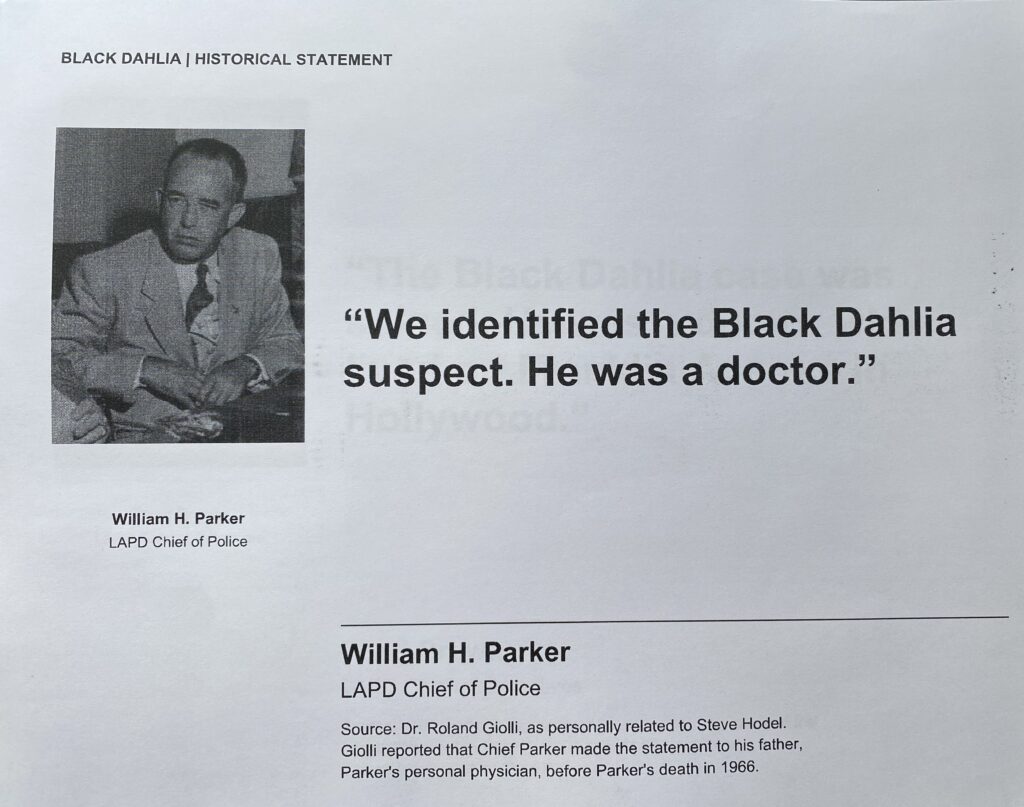
The source for this account was Dr. Roland Giolli, the son of Chief Parker’s personal physician. Dr. Giolli personally informed me that Parker had made the statement to his father before Parker’s death in 1966.
The source chain is therefore explicit: Chief Parker to his physician, and the physician’s son to me.
LAPD Chief of Detectives Thad Brown
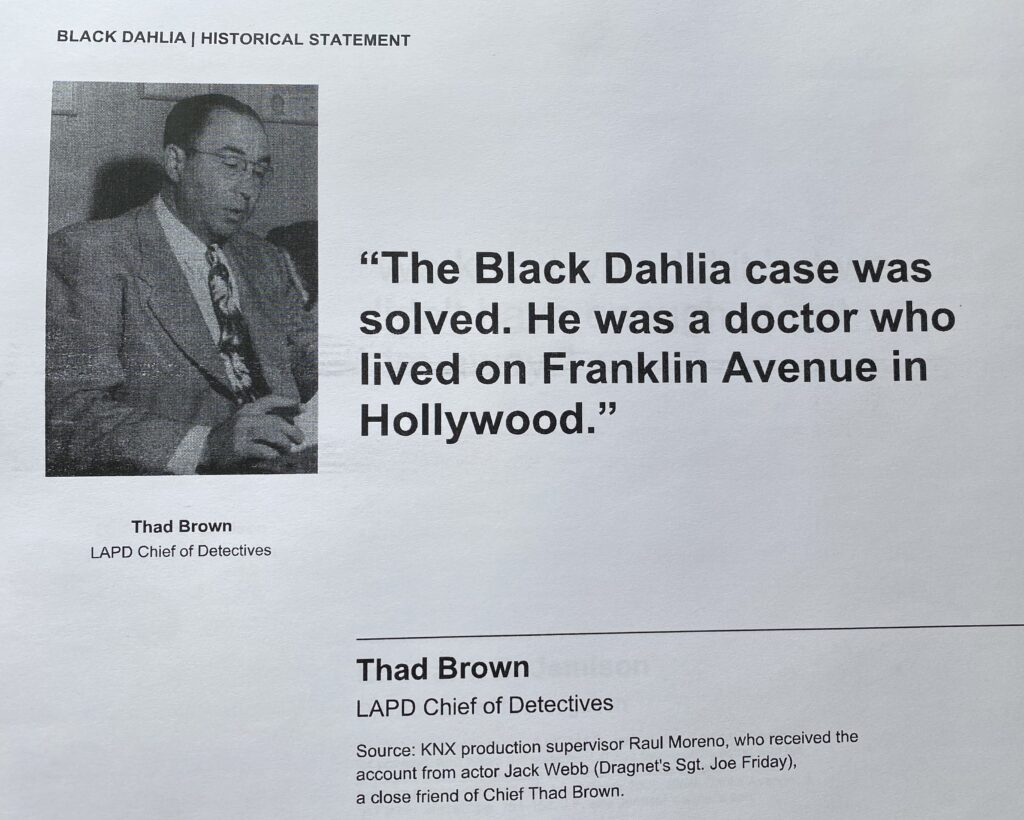
KNX production supervisor Raul Moreno related this account to me. Moreno identified his source as actor Jack Webb, who portrayed Sergeant Joe Friday on Dragnet and was a close friend of Chief Thad Brown.
Brown’s reported description included a particularly significant detail: a doctor who lived on Franklin Avenue in Hollywood.
My father, Dr. George Hill Hodel, lived at 5121 Franklin Avenue—the residence now widely known as the Sowden House.
District Attorney Investigator Lieutenant Frank B. Jemison
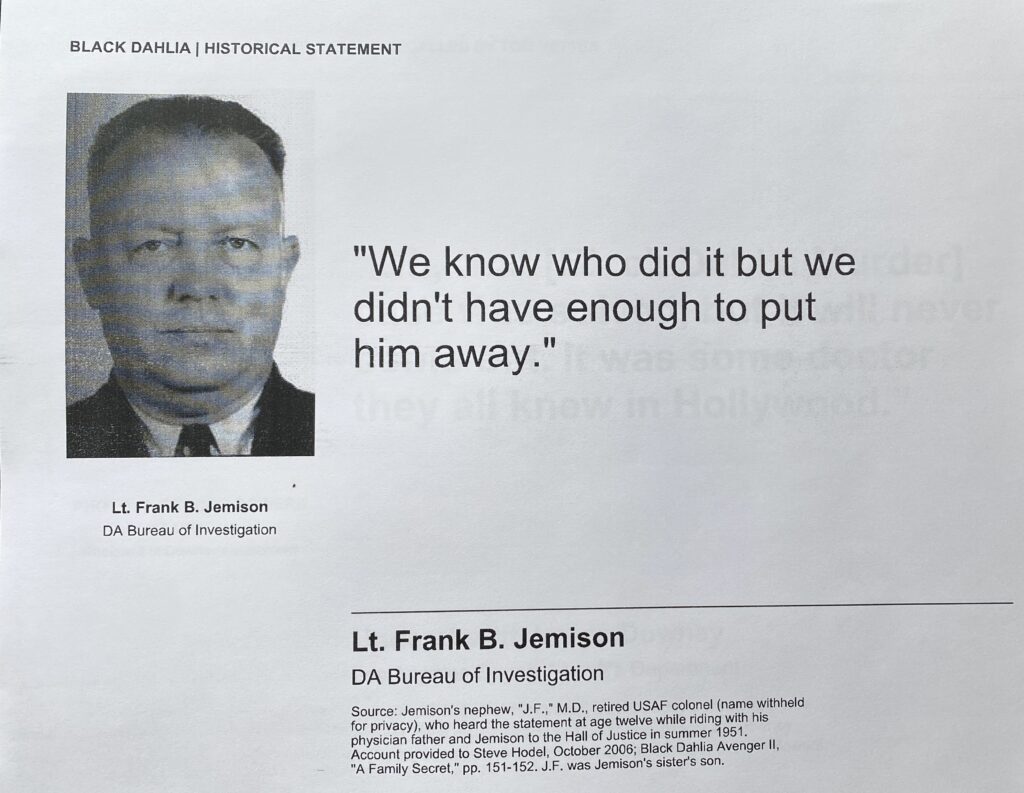
In Black Dahlia Avenger II, I reported an account provided to me in October 2006 by Lieutenant Jemison’s nephew, identified for privacy as “J.F.” He was the son of Jemison’s sister, a medical doctor, and a retired Air Force colonel.
He recalled his uncle’s statement at the Hall of Justice in the summer of 1951:
“The Dahlia murder suspect was a doctor, and we know who did it, but we couldn’t put him away.”
This was a family member’s recollection of a statement he personally heard. His account, including the circumstances of that meeting, is presented in Black Dahlia Avenger II.
Los Angeles County Undersheriff James Downey
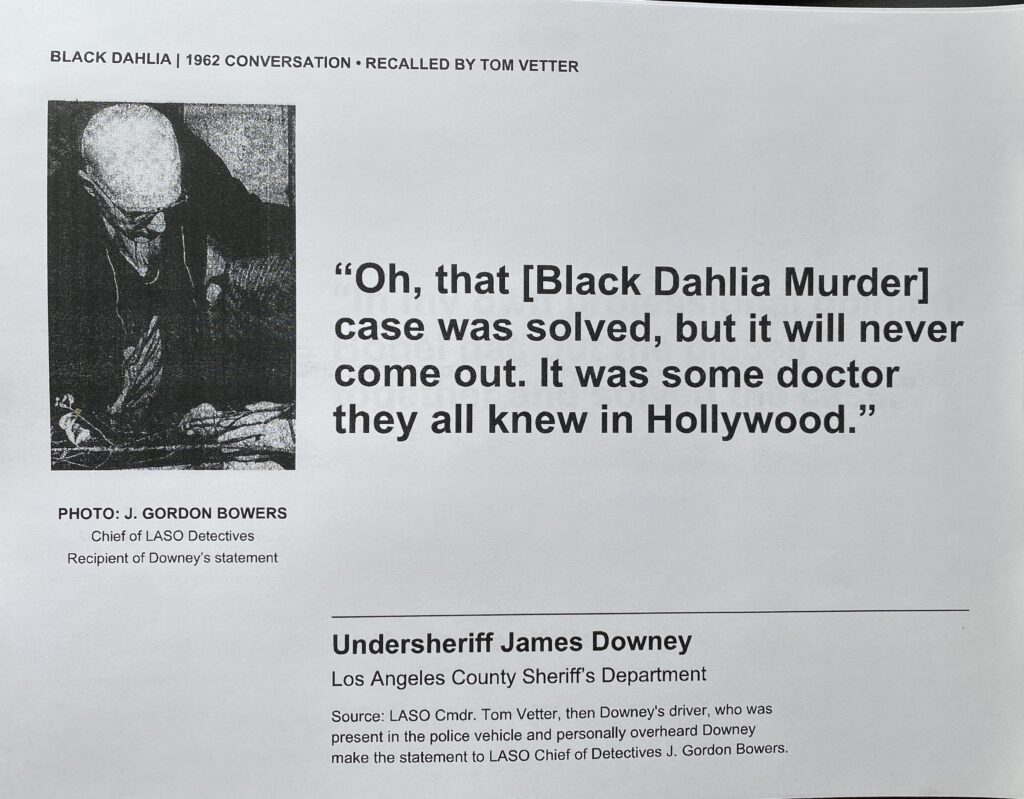
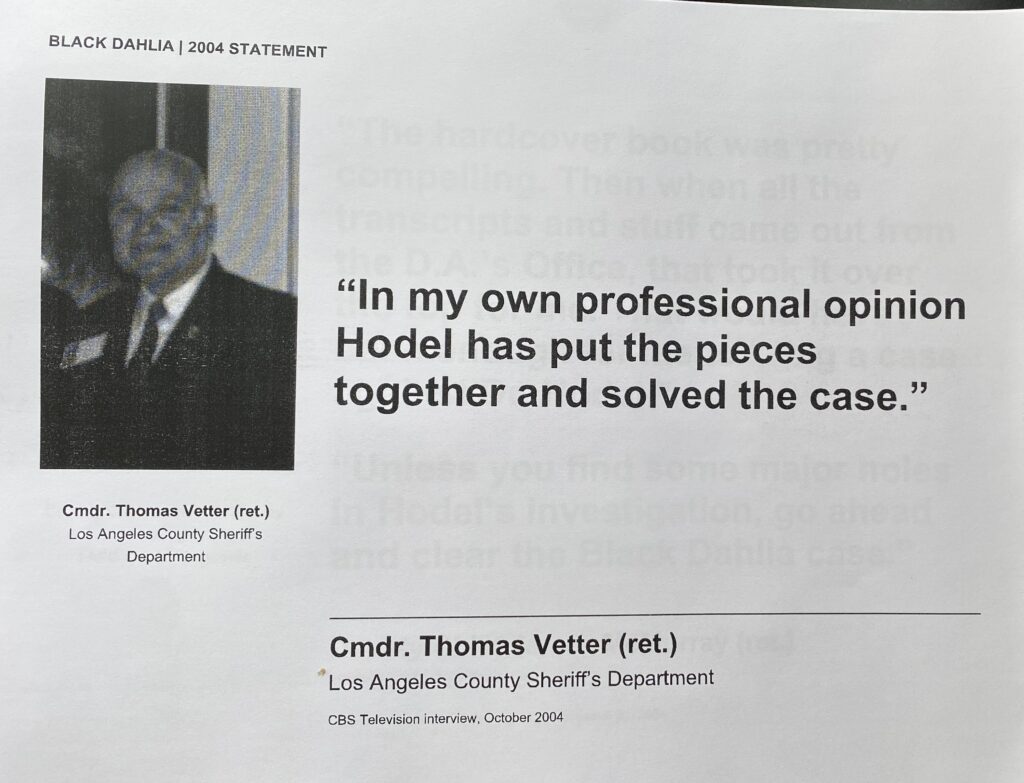
Retired Sheriff’s Commander Thomas Vetter was my source for this account. In 1962, while serving as Downey’s driver, Vetter was present in the police vehicle and heard the undersheriff’s remarks to Sheriff’s Chief of Detectives J. Gordon Bowers.
Vetter’s account identifies both the person speaking and the person being addressed, as well as his own presence when the statement was made.
The photograph accompanying this statement is of J. Gordon Bowers, who heard the remark, rather than Undersheriff Downey.
LAPD Deputy Chief James McMurray, Chief of Detectives
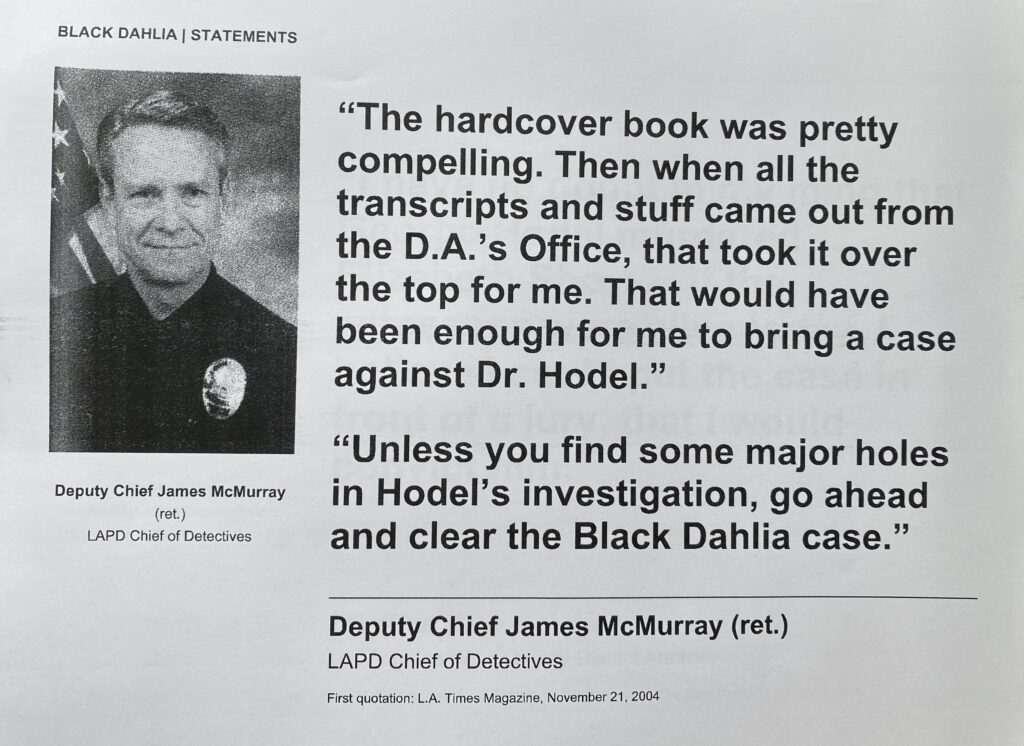
Source for second quotation: At the Hodel/Kay 2003 Black Dahlia presentation to senior LAPD officers at Parker Center, Chief of Detectives James McMurray gave this instruction to the Cold Case detectives then assigned to the Black Dahlia investigation.
McMurray’s statements belong alongside the earlier accounts, with an important distinction: they concern his assessment of my investigation decades after Elizabeth Short’s murder.
His position as chief of detectives gives that assessment particular significance. The accompanying page presents his statements with their respective sources.
Head Deputy District Attorney Stephen Kay
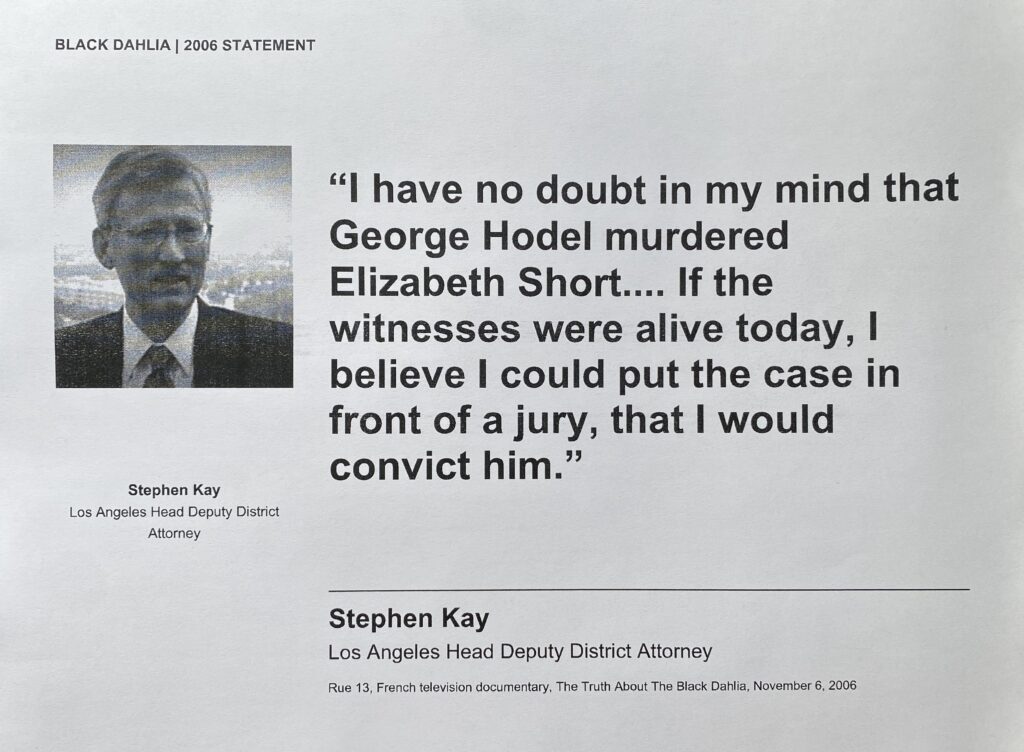
Stephen Kay reviewed my investigation and publicly expressed his conclusions concerning the evidence.
At the time of that review and those statements, Kay was a serving Head Deputy District Attorney, not a retired prosecutor. His assessment should be read in that context and alongside the evidence he examined.
Why Bring These Statements Together?
These accounts do not all have the same evidentiary character. A public interview, a witness’s recollection of a private conversation, and a statement relayed through named intermediaries must each be identified accurately.
That is why I have included the sources.
Nor does every statement name George Hodel. The references to a doctor, Hollywood, and Franklin Avenue must be considered in their actual wording and historical context.
These statements made separately on different occasions over the years following the 1947 murder and in fact corroborate each other by way of that independence.
Further, we know that they identified “the doctor that lived on Franklin Avenue” as Dr. George Hill Hodel by way of June 1949 LAPD grilling of him by detectives at LAPD for the suspected murders of the Black Dahlia and of Louise Springer as detailed in undercover informant Glenn Martin’s letters.
In my professional judgment, the circumstances described in Glenn Martin’s letters explain why LAPD brought George Hodel and Glenn Martin in for questioning in June 1949 and subsequently placed his home under surveillance in February–March 1950, following his arrest for incest and the subsequent trial in October-December,l 1949.
This resulted in the later, Feb-March 1950, five-week surveillance wire recordings and secret Hodel/Black Dahlia transcripts obtained in my 2003 investigation which contain Dr. Hodel’s admissions to killing Elizabeth Short and admissions to overdosing and killing his secretary, Ruth Spaulding in 1945, as well as payoffs to law enforcement and performing illegal abortions at his downtown clinic.
My conclusion that my father murdered Elizabeth Short rests on the larger body of evidence presented in my books and investigation. These statements form part of that record.
They deserve to be read together, with their sources visible, and considered on their merits.
Steve Hodel
Detective III, LAPD Hollywood Homicide (ret.)