“He Backed the Wrong Horse”: A Response to David Oranchak
October 24, 2026
Birch Bay, Washington
I have just reviewed David Oranchak’s latest YouTube video, Zodiac and Black Dahlia SOLVED! By Sherlock or Charlatan? (Part Three).
First, credit where credit is due. David’s in-depth background investigation into Alex Baber is impressive and professional. He has done a considerable amount of digging, examined Baber’s claims, and presented information the public needs to consider when evaluating his purported solutions to the Black Dahlia and Zodiac murders.
I respect the time, care, and investigative effort David has devoted to setting the Baber record straight. His examination of Baber’s background and his association with Michael Connelly, Mitzi Roberts, and Rick Jackson is a substantial contribution to that discussion. I highly recommend watching his presentation.
My disagreement concerns one specific passage. It does not diminish my appreciation for David’s extensive work.
“He backed the wrong horse before.”
Those are Oranchak’s words, immediately followed by a recording of Michael Connelly expressing regret for endorsing my book, Black Dahlia Avenger.
Here is the shortened excerpt so readers can hear the statements in context.
The passage begins with Larry Harnisch’s comparison of Connelly to Patricia Cornwell and her pursuit of Walter Sickert as Jack the Ripper. Oranchak then turns to Connelly’s earlier endorsement of my investigation, presenting that endorsement as a previous mistake.
In the recording, Connelly states:
“I read that book knowing very little about the case, and I found it convincing.”
He continues:
“I think I even said case closed or something like that. I can’t remember exactly what I said in endorsing that book.”
For the record, here is his original endorsement:
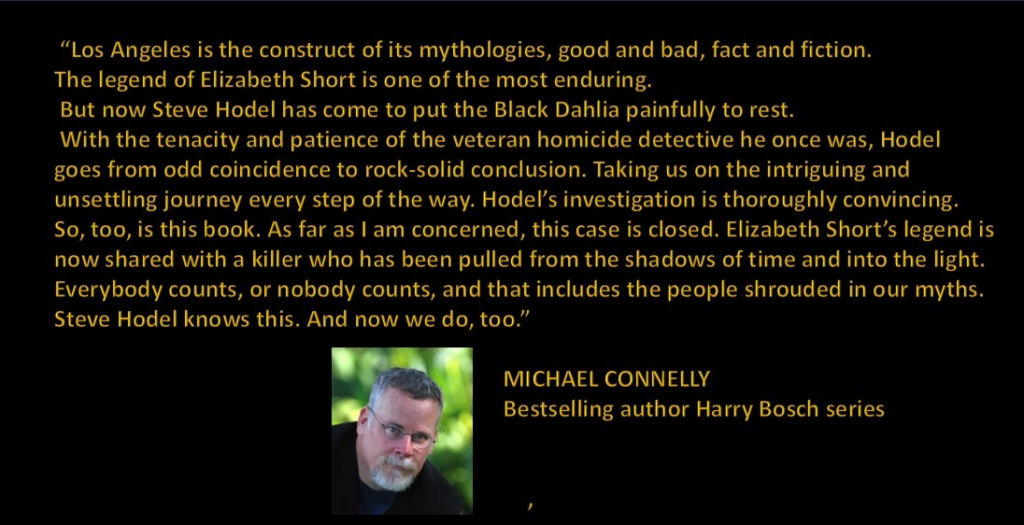
His wording was unequivocal:
“Hodel’s investigation is thoroughly convincing.”
And:
“As far as I am concerned, this case is closed.”
Connelly is entitled to change his opinion. But what evidence caused him to reverse that assessment? What investigative finding justified dismissing George Hodel as Elizabeth Short’s killer?
The excerpt provides no answer.
Mitzi Roberts’s earlier assessment
Connelly was not alone in finding the investigation compelling. In an April 2013 KMEX television interview, LAPD Detective Mitzi Roberts offered her own favorable assessment:
“I think he [Hodel] has made a very compelling theory.”
She went on to say that my father “could actually be responsible for the murder of the Black Dahlia.”
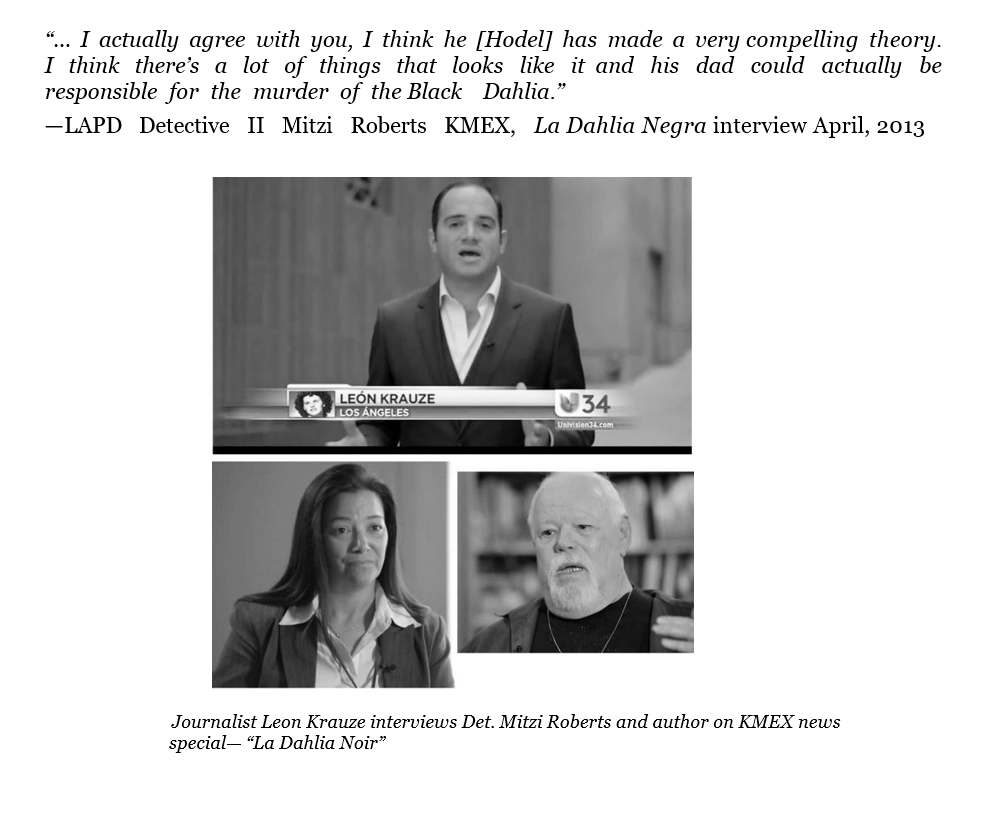
I have published these statements before, but they bear repeating here. Roberts’s words were qualified, yet clearly acknowledged the strength of the investigation. Readers evaluating her present position deserve to know that earlier assessment and what evidence subsequently changed it.
The assessments of experienced law enforcement officials
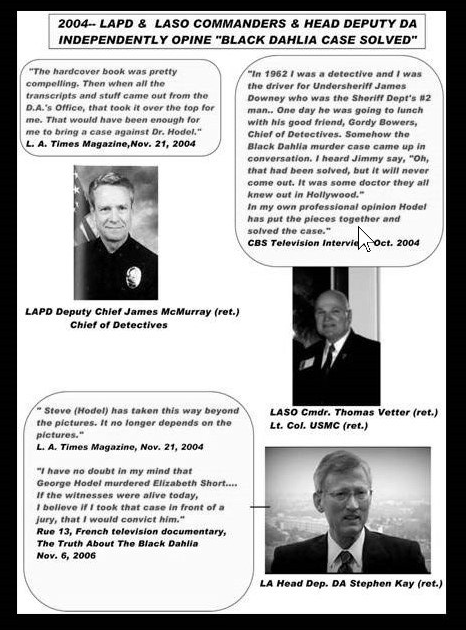
My investigation also received support from experienced law enforcement officials who reviewed the evidence.
James McMurray, then commander on LAPD, and then Chief of Detectives, stated:
“Unless you find some major holes in Hodel’s investigation, go ahead and clear the Black Dahlia case.”
The qualification matters. Find the holes. Examine the evidence. Determine whether the investigation holds up.
Then-active Head Deputy District Attorney Stephen Kay reviewed my investigation and joined me in presenting the evidence to LAPD command staff and Cold Case Unit detectives. His involvement went well beyond offering an opinion on a book. Kay stated:
“I have no doubt in my mind that George Hodel murdered Elizabeth Short. If I presented this before a Jury, I believe I would convict him, (George Hodel).”
These were assessments by professionals with extensive experience in homicide investigation and prosecution. They deserve consideration alongside Connelly’s change of opinion.
The historical record
My research also includes accounts attributed to former LAPD Chief William H. Parker, Chief of Detectives Thad Brown, District Attorney investigator Lt. Frank Jemison, and LASD Undersheriff James Downey.
These accounts describe the suspect as a doctor. Chief Brown’s account further identifies him as a doctor who lived on Franklin Avenue in Hollywood.
George Hodel was a physician whose residence, the Sowden House, was on Franklin Avenue.
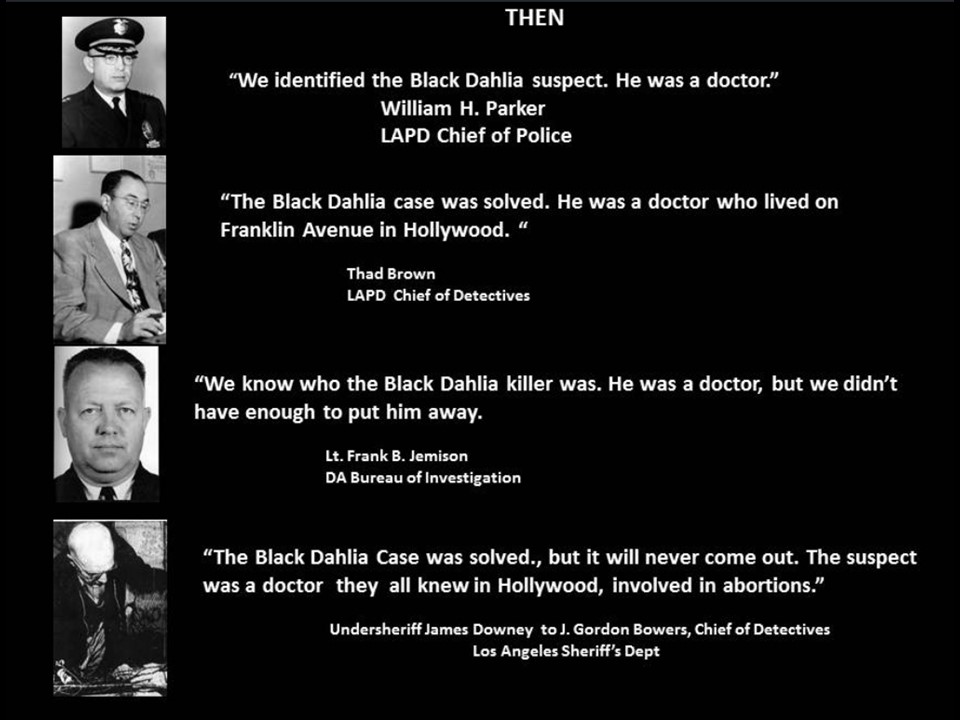
These historical accounts differ in their wording and circumstances. Some were recollections of earlier conversations. They should be considered individually, with their sources. They are nevertheless part of the record I have presented and deserve examination.
The distinction between investigators believing they had identified the killer and having sufficient evidence to prosecute him is central to this history. My conclusion, based on the records and evidence presented in my books, is that investigators identified George Hodel, obtained secret wire-recordings of him admitting to the crimes and “payoffs to law enforcement” but failed to bring him to trial.
That is my conclusion, and I have spent nearly three decades documenting why I reached it.
The supporting assessments of McMurray, Kay, and others do not constitute a court judgment or a formal departmental clearance. They do establish that Connelly’s original endorsement was accompanied by favorable assessments from experienced law enforcement professionals.
What made it the “wrong horse”?
David, I welcome scrutiny of my investigation. If there are factual errors, identify them. If evidence contradicts my findings, present it.
I respect the investigative standard you have brought to examining Alex Baber’s claims. I ask that you apply that same standard before characterizing Connelly’s endorsement of Black Dahlia Avenger as an established mistake.
Connelly’s regret tells us that he changed his opinion. It does not explain what evidence justified that change.
“He backed the wrong horse” is a conclusion. Readers deserve to see the evidence behind it.
Detective III Steve Hodel #11394
LAPD Hollywood Homicide Detective (Ret.)