THE 1947 JEANNE FRENCH MURDER HEELPRINT EVIDENCE REVISITED: AN INTERNATIONAL TRACKING EXPERT REVIEWS THE EVIDENCE
June 16, 2026
Birch Bay, Washington
For decades, researchers examining the February 10, 1947 murder of Jeanne French have cited a detail contained within the original LAPD investigation: a partial heel impression reportedly found on the victim’s body.
Excerpted reference to “heel prints” from LAPD’s 1947 Jeanne French murder summary:

According to the police report, investigators speculated that the impression may have been made by a relatively small man’s shoe, possibly in the size 6-7 range. At the same crime scene, larger shoeprints were reportedly observed in the vicinity of the body. Investigators suggested that those larger prints may have resulted from contamination by reporters, detectives, or others present after discovery of the crime.
As with many details found in historic homicide investigations, it is worthwhile to occasionally revisit the original evidence and ask a simple question:
What can actually be determined from the surviving record?
Recently, I asked internationally recognized tracking expert and footwear impression analyst Kyt Lyn Walken to review the available materials relating to the Jeanne French murder. Given her extensive experience in mantracking, footprint interpretation, and footwear impression analysis, I was interested in obtaining an independent assessment of the oft-cited heelprint evidence.
KYT LYN WALKEN
MANTRACKING SCHOOL – The Way of Tracking – HULL’s TRACKING SCHOOL – EUROPE and U.S.



Kyt Lyn Walken is an internationally recognized mantracking instructor, footwear impression analyst, author, and field-sign specialist. She serves as the European representative and instructor for Hull’s Tracking School and is founder of The Way of Tracking, an organization dedicated to the study and instruction of human tracking, footprint interpretation, and forensic field-sign analysis.
Her work has included training, consulting, and instruction in mantracking, footwear impression analysis, search-and-rescue operations, anti-poaching investigations, and forensic tracking applications. Through her courses, publications, and field work, she has trained students from numerous countries and has become a respected voice within the international tracking community.
What particularly impressed me during our correspondence was her commitment to evidence-based analysis. Rather than attempting to fit evidence to a theory, she consistently emphasized the importance of careful observation, critical thinking, and recognizing the limitations of the available data.
A FRESH LOOK AT AN OLD QUESTION
After reviewing the available photographs, documentation, and related materials from the Jeanne French investigation, Kyt Lyn offered an observation that immediately caught my attention.
Rather than attempting to identify a suspect from the evidence, she focused on the limitations of the evidence itself.
In her assessment, the available photographs depicting the alleged stomp-related injuries are of limited forensic value due to their resolution and lack of measurable reference points. As a result, she cautioned against drawing definitive conclusions regarding shoe size from the surviving imagery alone.
As she explained, numerous variables affect the appearance of stomp-related injuries, including force, angle of impact, body composition, footwear type, environmental conditions, and postmortem changes.
In short, the surviving evidence does not provide a sufficient forensic foundation to reliably determine that the offender wore a men’s size 6 or 7 shoe.
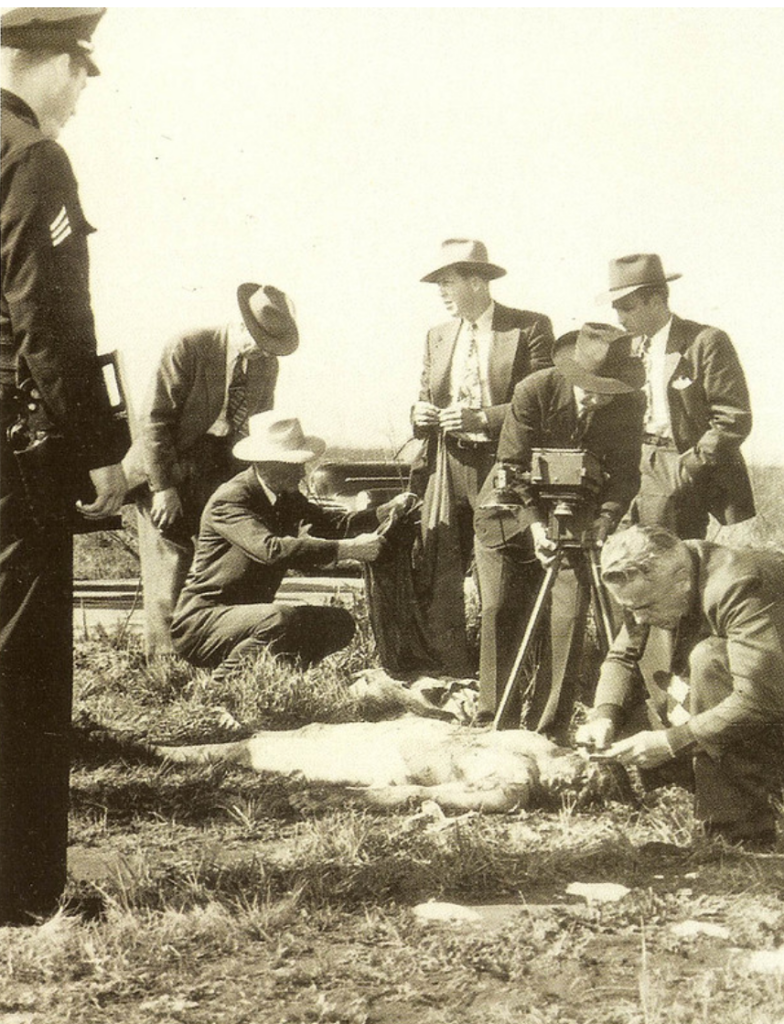
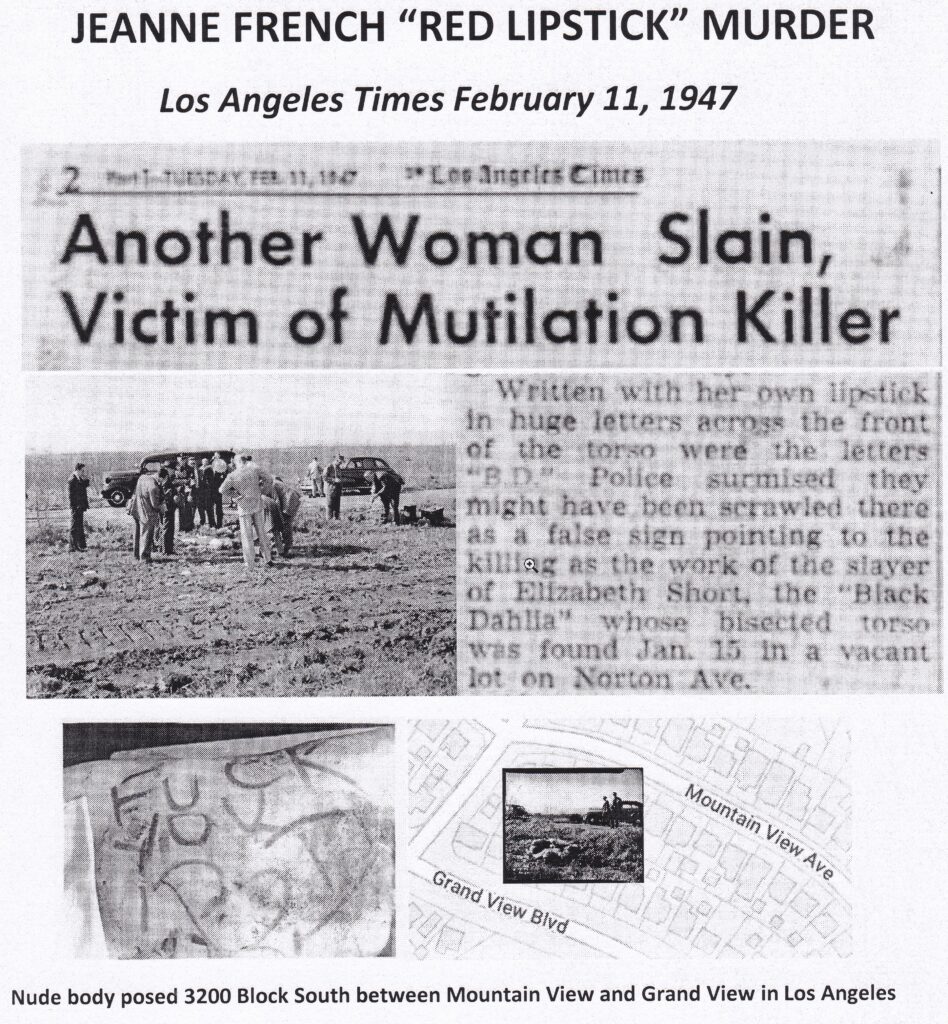
LAPD Detectives at Jeanne French crime scene Feb. 10, 1947
Kyt Lyn goes on to state:

THE LARGER SHOEPRINTS
Equally interesting was her assessment of the larger shoeprints reportedly observed near the victim’s body.
Historically, these larger impressions have often been dismissed as possible contamination from individuals present at the scene after discovery of the crime.
Kyt Lyn noted that such a conclusion remains speculative.
In her opinion, the larger prints could just as easily have belonged to the offender. Based upon the surviving documentation, there is insufficient evidence to automatically exclude that possibility.
Again, the point is not to prove who left those impressions.
The point is that the larger shoeprints cannot be dismissed with certainty.
THE IMPORTANCE OF REVISITING EVIDENCE
One of the lessons I have learned during more than three decades of investigating historic murders is that observations and conclusions are not always the same thing.
An observation may be factual.
A conclusion may be speculative.
Over time, however, speculation can sometimes harden into accepted fact.
What I found most valuable about Kyt Lyn’s review was not that it supported any particular suspect theory. Rather, it reminded us of the importance of returning to the original evidence and carefully separating what is known from what is assumed.
Based upon her analysis, the surviving evidence from the Jeanne French crime scene does not permit a reliable determination that the offender wore a men’s size 6-7 shoe. Likewise, the larger shoeprints observed near the body cannot be automatically dismissed as irrelevant.
Those conclusions may not solve the Jeanne French murder.
But they do help clarify what the evidence actually says—and perhaps more importantly, what it does not say.
A sincere THANK YOU to Kyt Lyn for her review and analysis of the 1947 Jeanne French Murder footprint evidence.
— Steve Hodel
Kyt’s advice is applicable to all types of investigation. I will keep it uppermost in mind when I am doing research. it is perhaps the most valuable approach you can take with regard to evidence.
Thanks for another great post.