BLACK DAHLIA MYTH-BUSTING: THE “MISSING WEEK” THAT NEVER WAS
July 3, 2026
Birch Bay, Washington
Happy 4th of July!
How an LAPD Police Bulletin Helped Create a Black Dahlia Legend—and How the Witnesses It Generated Destroyed It
For decades, one of the most repeated claims in the Black Dahlia case has been that Elizabeth Short “disappeared” after she was dropped off at the Biltmore Hotel on January 9, 1947, and was not seen again until her mutilated body was discovered six days later, on January 15. Over time, that alleged disappearance hardened into accepted Dahlia folklore and is now routinely referred to as Beth’s “Missing Week.”
There’s just one problem.
There never was a “Missing Week.”
Like so many long-accepted Black Dahlia “facts,” this one did not begin with proof. It began with repetition—specifically, repetition of a police request for information that later writers and armchair sleuths mistook for established fact. In this instance, the source of the legend can be traced directly to the LAPD Daily Police Bulletin of January 21, 1947, issued six days after Beth’s murder and circulated throughout downtown Los Angeles to hotels, apartment houses, cocktail lounges, bars, and nightclubs. The bulletin requested information on Elizabeth Short’s whereabouts “between dates January 9 and 15, 1947” and stated that she had last been seen on January 9 when she got out of a car at the Biltmore Hotel.
That bulletin was not a historical conclusion that Beth vanished after the Biltmore. It was an investigative request for leads—an appeal for anyone who had seen or dealt with her during those dates to come forward. But because the bulletin framed the open period as January 9 through January 15, and because it was distributed throughout the very hotels, bars, apartment houses, and rooming houses Beth frequented, it planted the seed of a false narrative in the public’s mind: that Elizabeth Short had simply vanished for a week.
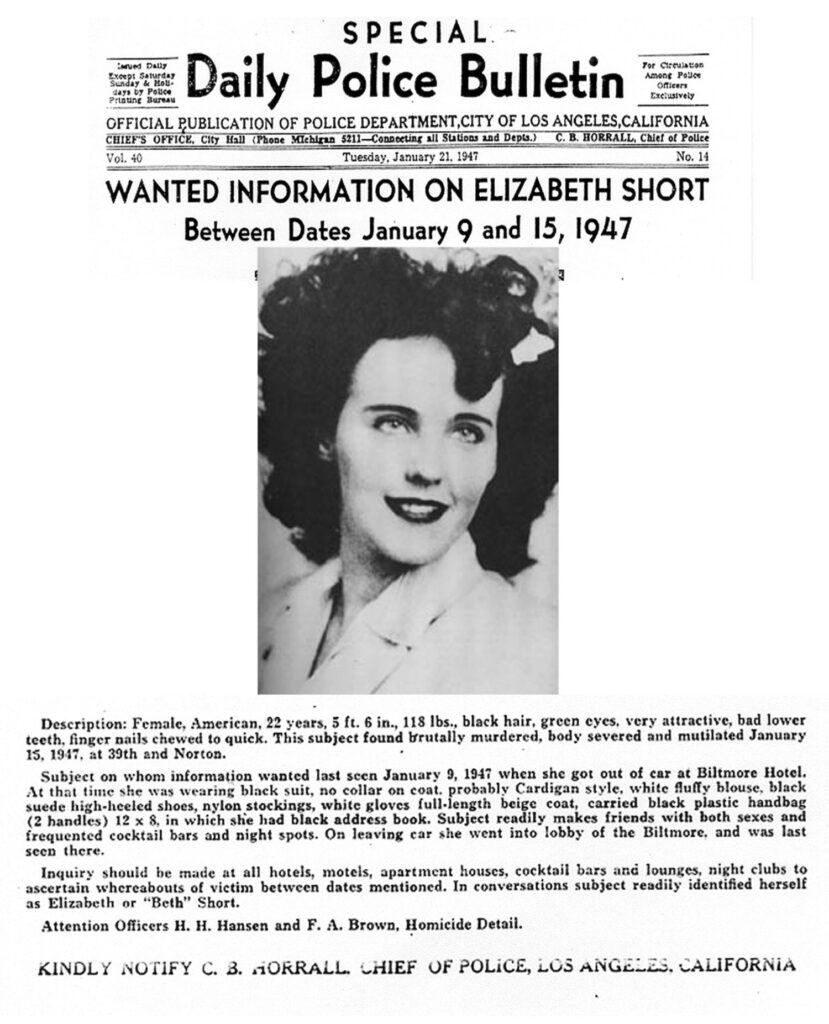
In time, that investigative request hardened into accepted “fact.”
There is a great irony here. The same LAPD publicity that helped create the “Missing Week” legend also helped destroy it. The police bulletin and subsequent newspaper coverage prompted witnesses to come forward—witnesses from bars, hotels, restaurants, gas stations, and downtown locations who had seen Beth during the very days she was supposedly “missing.” Some were casual observers. Others knew Elizabeth Short personally and were not mistaken. Still others had direct face-to-face contact with her and later made positive identifications. When those witness statements are assembled—as I have done over the years from newspaper files, police records, DA reports, and later-discovered interviews—the “Missing Week” simply collapses.
What emerges instead is a very different picture: Elizabeth Short was alive, moving about Los Angeles, and seen repeatedly between January 9 and January 14, 1947.
A Key Pre–Missing Week Witness: Jack Egger
Before turning to the formal Jan. 9–14 “Missing Week” chronology, one witness belongs just ahead of it: Jack Egger.
In early January 1947, Egger was a young CBS usher working at CBS Columbia Square, 6121 Sunset Blvd., Hollywood. He later served as a Los Angeles County DA investigator, then as a Beverly Hills police captain, and after retirement became Security Chief at Warner Bros. Studio. While working at CBS in early January 1947, Egger repeatedly saw Elizabeth Short “More than twenty times” in line and knew her on sight. He also encountered the older man accompanying her—a man who flashed a badge and identified himself as a Chicago police officer. On that occasion, he allowed them to “jump the line and enter the radio show.” Egger never forgot the incident. Years later, he positively identified Elizabeth Short as the woman he had seen and Dr. George Hodel as the so-called “Chicago policeman” who badged him.
Egger’s sighting predates the formal “Missing Week” by several days, but it matters because it places Beth in George Hodel’s company immediately before the final week of her life. In other words, Beth’s last-week chronology does not begin in a vacuum at the Biltmore on January 9. It begins with witnesses already placing her in the company of the man I identify as her killer.
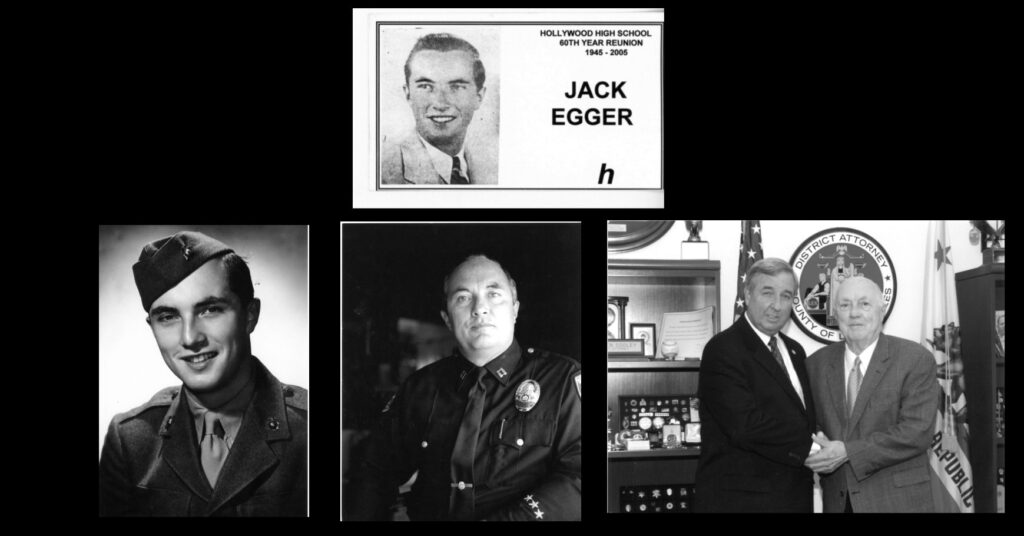
Jack Egger through the years — CBS usher, later Los Angeles County DA investigator, and later Beverly Hills police captain. At far right, Egger is shown with then–Los Angeles District Attorney Steve Cooley. Egger placed Elizabeth Short with George Hodel, later identifying him as the “unknown Chicago police officer.”
The Witnesses Who Place Elizabeth Short During the So-Called “Missing Week”
Over the years, by combining witness statements I first located while researching Black Dahlia Avenger with later discoveries from DA files, police records, and follow-up investigation, I assembled a consolidated witness list placing Elizabeth Short in Los Angeles during the very days she was supposedly “missing.”
Some of these witnesses knew Beth personally. Others knew her as a regular. Still others had direct face-to-face contact with her and later positively identified her. Taken together, their statements do not describe a vanished woman. They describe a woman still moving about Los Angeles in the final days before her murder.
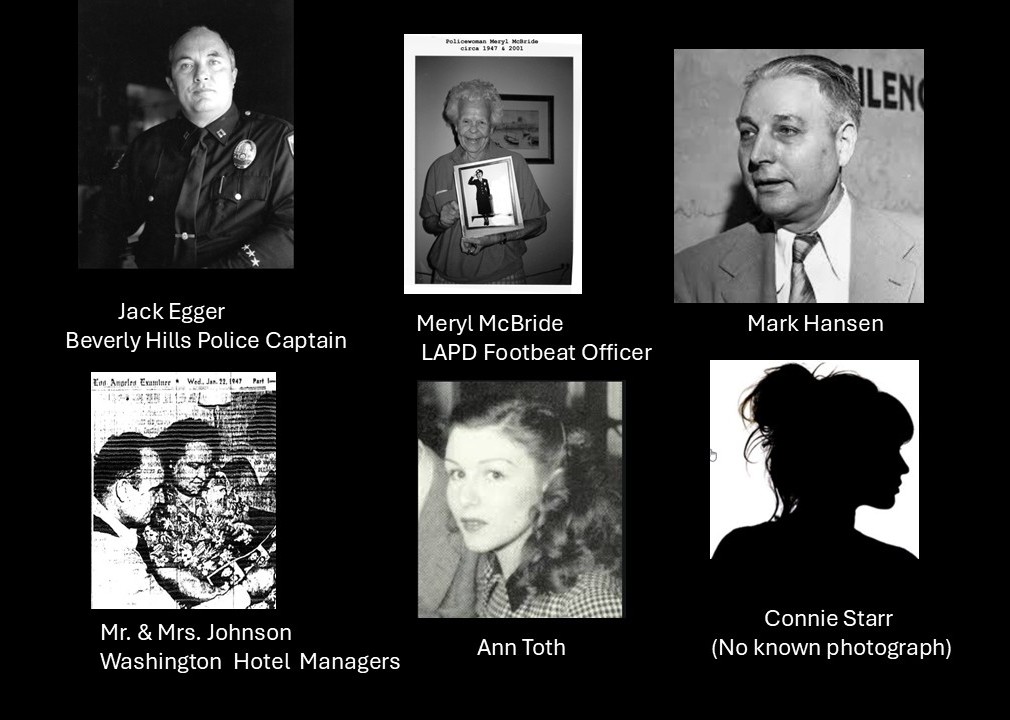
Witnesses highlighted below in red personally knew Elizabeth Short—or knew her as a regular—and were not mistaken in identifying her.
January 9 or 10, 1947
Iris Menuay — Chancellor Hotel, 1842 N. Cherokee, Hollywood. Menuay saw Beth in the hotel lobby embracing a man dressed like a gas-station attendant or in uniform.
January 10, 1947
Buddy LaGore — bartender at the Four Star Grill, 6818 Hollywood Blvd. Beth was a semi-regular there. LaGore saw her at the bar late that evening.
John Doe No. 1 — in the 7200 block of Sunset Blvd., saw Beth in a black coupe with two women. He overheard them say they were staying at a motel on Ventura Blvd. and were on their way to the Flamingo Club on La Brea Ave. He later positively identified Beth from police photographs.
January 11, 1947
John Doe No. 2 — a gas-station attendant at the Beverly Hills Hotel, whose identity police kept secret. At approximately 2:30 a.m., he positively identified Beth in a 1942 tan coupe. Elizabeth was in the back seat and appeared frightened and upset. The driver was described as a male about thirty, 6 feet tall and 190 pounds. A second female occupant in the car was wearing dark clothing.
Paul Simone — a painting contractor living in Hollywood who was working at the Chancellor Hotel that Saturday, January 11. Beth had stayed at that same hotel the previous month, sharing Room 501 with seven women. Simone told police that while working at the building he heard loud arguing coming from the rear of the hotel. When he went to investigate, he saw Elizabeth Short involved in what he described as “a bitter argument” with another woman. The woman was “cursing loudly at Elizabeth,” and Simone thought the two were on the verge of a fight. When Simone approached, the woman turned and shouted, “Oh, nuts to you!” before storming out. Beth then asked Simone, “Is there a rear exit to the hotel?” When he told her there wasn’t, Simone walked her to the front door, where she got into a waiting taxi.
I.A. Jorgenson — a cabdriver who positively identified Elizabeth Short as the woman he picked up outside the Rosslyn Hotel at 6th and Main, downtown Los Angeles, on January 11. Beth was accompanied by a man. Jorgenson drove the pair to a hotel in Hollywood, but police later refused to release either the hotel’s name or the description Jorgenson gave of the male companion.
Connie Starr, Ann Toth, and Mark Hansen — all place Beth at Mark Hansen’s residence, 6024 Carlos Ave., Hollywood, for dinner on the evening of January 11, 1947. Starr and Toth both knew Beth personally, as did Hansen. This dinner is one of the key anchors in Beth’s final-days chronology because it places her squarely in Hansen’s Hollywood orbit one day before she was checked into a downtown hotel under an assumed name.
January 12, 1947
C. G. Williams — bartender at the Dugout Café, 634 S. Main St., downtown Los Angeles. Beth was a regular customer there. On the afternoon of January 12, Williams saw Beth in the café with an attractive blonde woman. Two men attempted to pick up the women and were rejected.
Mr. and Mrs. Johnson — managers of the Washington Hotel, 300 E. Washington Blvd., downtown Los Angeles. On January 12, an unidentified man came to the hotel alone and booked a room, but refused to sign the register, telling the Johnsons to enter: “Mr. and Mrs. Barnes from Hollywood.” The Johnsons described him as a white male, 25 to 35 years of age, of medium height and weight. About an hour later, Elizabeth Short arrived with him. The Johnsons later positively identified Beth as the woman accompanying him. This was the last time they saw her alive.
January 13, 1947
John Jiroudek — a former jockey who knew Beth from Camp Cooke, where she had been chosen “Camp Cutie” in a beauty contest. On January 13, Jiroudek saw Beth at the corner of Hollywood Blvd. and Highland as a passenger in a 1937 Ford sedan driven by a blonde woman.
January 14, 1947
Officer Meryl (Myrl) McBride — one of the most important final-days witnesses. On January 14, McBride saw Beth twice in downtown Los Angeles. In the first encounter, near the bus depot area around 5th and Main, Beth ran to her crying, upset, and frightened. Later that same day, McBride saw Beth again, this time emerging from a bar with “two men and a woman.” Beth told McBride she was on her way to meet her parents at the bus station.
January 15, 1947
This was not a live sighting of Beth, but it is a critical final movement event. On January 15, Mr. Barnes returned alone to the Washington Hotel and checked out, acting nervous and shaken. According to the Johnsons, Mr. Johnson joked to him that he had not seen him in three days and thought maybe he was dead. Whoever “Mr. Barnes” was, he had checked Beth into the Washington Hotel on January 12 and returned alone to close out the room on the very day her body was discovered.
What These Witnesses Show
Once the witness record is laid out, the “Missing Week” is impossible to sustain. Elizabeth Short did not simply vanish after the Biltmore on January 9. She was seen at the Chancellor Hotel, the Four Star Grill, on Sunset Blvd., at Mark Hansen’s residence on Carlos Avenue, at the Dugout Café, at the Washington Hotel, and twice by Officer Meryl McBride on the day before her body was found.
More important, this is not a witness list made up of vague newspaper “look-alike” sightings. Several of these witnesses knew Beth personally—including Connie Starr, Ann Toth, Mark Hansen, Buddy LaGore, and John Jiroudek—and were not mistaken. Others, including C. G. Williams, knew her as a regular. Still others—the Johnsons, Paul Simone, Jorgenson, and Officer McBride—had direct face-to-face contact with Beth and later positively identified her. In short, this is not one isolated sighting. It is a witness chain.
That chain also tells us something else: Beth appears to have had freedom of movement during these final days. If the Johnsons are correct that she was checked into the Washington Hotel on January 12 by the man calling himself “Mr. Barnes from Hollywood,” then the evidence strongly suggests she was not being held continuously captive there. She was still out and about downtown on January 14, where Officer McBride saw her twice. Whatever role “Mr. Barnes” played in the final sequence, the chronology does not support the simplistic notion that Beth disappeared after the Biltmore and was never seen again.
Where the Myth Came From
So how did the “Missing Week” survive for so long?
The answer is simple: an LAPD request for information was repeated, over and over, by writers who accepted it at face value and never followed the witness trail it generated. The Jan. 21, 1947 police bulletin stated that Beth had last been seen at the Biltmore on Jan. 9 and requested information on her whereabouts between Jan. 9 and Jan. 15. That bulletin was then circulated through the very neighborhoods, hotels, bars, and rooming houses where Beth had actually been. The public and the press naturally interpreted it to mean she had vanished. Later authors repeated the assumption. And with each repetition, the “Missing Week” legend became more deeply embedded in Black Dahlia lore.
But the actual witness record tells a very different story.
The “Missing Week” was never an established historical fact. It was a police information gap, magnified by publicity and later mistaken for certainty. The irony is that the same publicity which helped create the myth also generated the witnesses who disproved it.
Conclusion
The Black Dahlia’s so-called “Missing Week” never existed in the way it has long been described. Elizabeth Short did not vanish into thin air after the Biltmore on January 9 and remain unseen until her body was found on January 15. What existed was an investigative gap—a period the LAPD wanted help filling in after her murder. Once that request was broadcast throughout downtown Los Angeles and beyond, witnesses came forward.
Some knew Beth personally. Some knew her as a regular. Others dealt with her directly and later positively identified her. Taken together, they place Elizabeth Short repeatedly in Los Angeles between January 9 and January 14, 1947.
In short, the “Missing Week” was not a mystery. It was a myth.
And like so many myths in the Black Dahlia case, it began with a police bulletin—and ends with the evidence.