East Meets West — A Case, A Gift, A Turning Point
March 31, 2026
Birch Bay, Washington
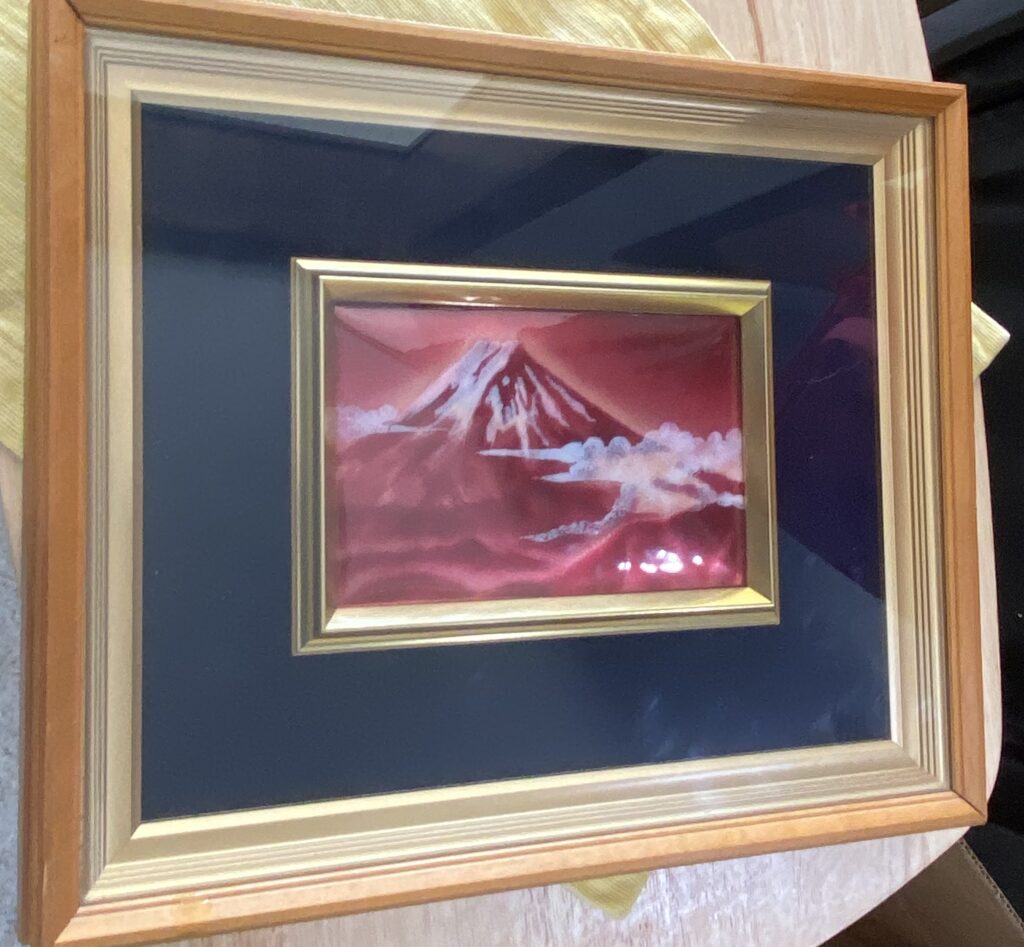
Front of artwork
Shippo enamel “Red Fuji,” Kyoto technique. Gifted in Tokyo, April 1999.
In April 1999, I returned from Japan after working as a defense investigator on a high-profile case involving a Japanese national accused of acting as the gunman in a Los Angeles murder. He spent four years in custody while the case moved slowly through the Tokyo courts, brought out for brief sessions of testimony and then returned to his cell—sometimes for weeks at a time.
The case itself was highly unusual and involved two defendants pursued under separate theories. The alleged crime—a 1982 shooting in downtown Los Angeles—was never charged locally due to insufficient evidence. Years later, after a joint LAPD/Tokyo Metropolitan Police investigation, Japanese authorities brought charges in Tokyo under “Letters Rogatory,” allowing prosecution of their nationals for crimes committed abroad. My work was limited to one of the accused. Japan’s conviction rate at the time exceeded 99 percent.
My investigation continued for several years and ultimately established his innocence. The Tokyo court returned a not guilty verdict.
The prosecution exercised its right to appeal. A three-judge tribunal ultimately upheld the acquittal.
Only after that process was complete did the client and his defense attorneys invite me back to Tokyo. At the close of a small celebration, the man I had worked to help free presented me with a framed piece of Japanese artwork—a red image of Mount Fuji rendered in enamel, accompanied by a translated note explaining its meaning.
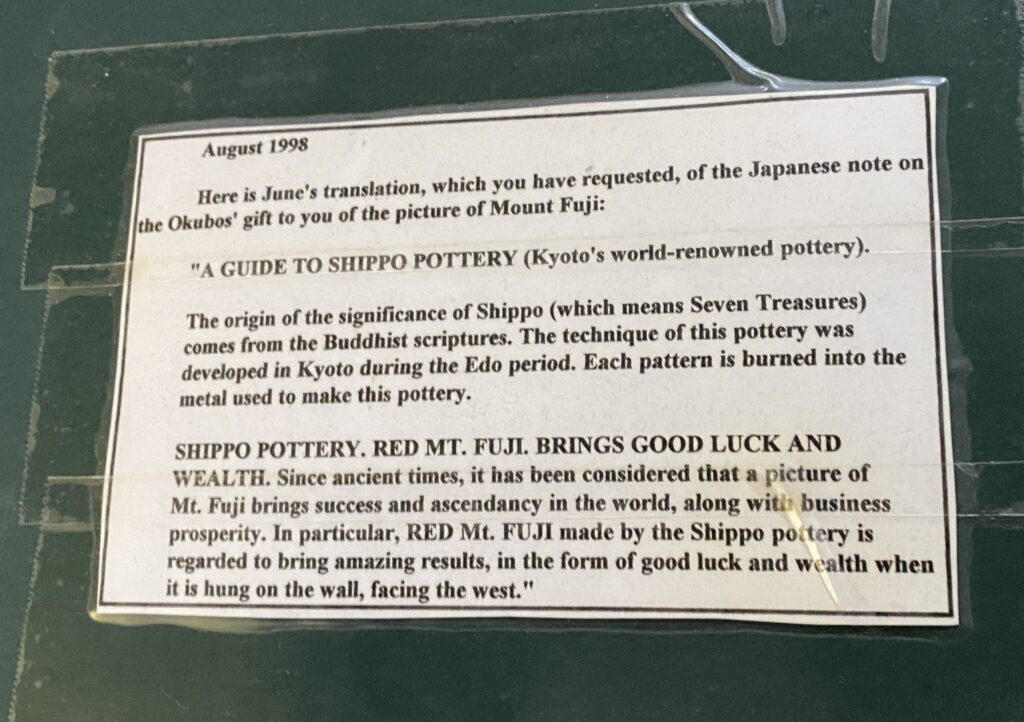
Original note accompanying the gift. Instruction: hang facing west.
The technique was called Shippo— “Seven Treasures”—a traditional Kyoto method of firing enamel onto metal. The image was “Red Fuji,” a rare and auspicious view of the mountain at sunrise, associated with good fortune, success, and favorable outcomes.
The note included a specific instruction: hang the piece on a wall facing west.
I did.
Within days of returning to Los Angeles, my father died.
That moment marked the beginning of another investigation—one that would ultimately define the next phase of my life. It also marked the end of two habits I had carried for years. I stopped drinking. I stopped smoking. Permanently.
No ceremony. No relapse.
Looking back, the timing is difficult to ignore. I had just helped restore a man’s future. In return, he gave me an object rooted in his culture—something intended not just as a gift, but as a symbol of alignment, of favorable conditions coming together at the right moment.
“Red Fuji” is said to appear only under specific circumstances—when light, atmosphere, and timing converge. In Japanese tradition, it represents a rare turning point.
That is exactly what followed.
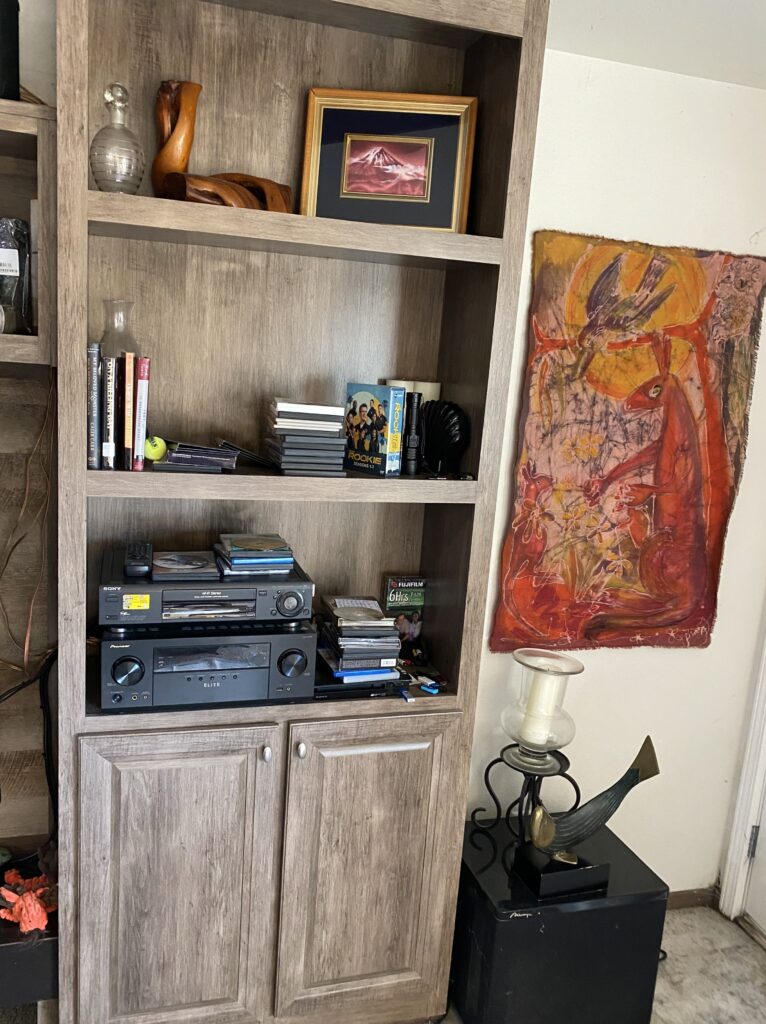
The piece still hangs on my wall today, facing west, where it has been for more than twenty-five years.
The piece as it hangs today, facing west.
I don’t consider it a charm or superstition.
But I do recognize what it came to represent:
A moment when two worlds intersected—East and West, justice and injustice, past and future—and something shifted.
We have remained in contact over the years.
He rebuilt his life in Japan—returned to his family, raised children, and became a grandfather.
For an investigator, most cases end on paper. Files close. Verdicts are entered. You move on.
This one didn’t.
You don’t always get to see what happens after.
In this case, I did.
That, more than anything, tells me the case reached the right outcome.
Thanks for sharing this part of your history. The fact that strangers from another country asked for your help in a case based in LA is evidence of your skills as an investigator.
Kudos for helping to get a not guilty. verdict The innocent should never be held accountable for things they did not do.
Your dogged pursuit of justice is welcome in a world now seemingly without much of it.
Thanks Ron.
Yes, serving prison time and being innocent is an abolute HORROR. Most researchers estimate that somewhere around 4 to 6 percent of those incarcerated in the United States may be innocent — tens of thousands of people. All Best, Steve
Hi, I am new here. Today I listened to the 8 part podcast series your family did. Absolutely mind blown. You all did an incredible job and I cannot wait to order your books. What are the first 2 you recommend first? I find myself deeply moved with your resilience, depth of detail and kind disposition. The political history of the 1940’s is fascinating and I look forward to diving in.
Hi Julie: Thanks for the kind words. Much appreciated. I recommend my first book, Black Dahlia Avenger. But, order the latest updated version which is on Amazon and updated 2025. Link here: https://www.amazon.com/Black-Dahlia-Avenger-Closed-Definitive-ebook/dp/B0FMKM1FGT/ref=sr_1_1?crid=UH4MVTYZK295&dib=eyJ2IjoiMSJ9.0ckgdVQlcViKoeE1d4PYFX4rjWvrGeRzdpQuohkORdb8T8QEqu0OKmNGvCBYBJ7rHdsLedzUnuCWuUlhyqEWRNgrbr7p8XlYwl-MCabkwig02tZhpiLpoy-PnvCParIpwBtBRWMl39qGo2UauC3fRA.u-w5CUkxGkhv1ay4r7OzdgfbGJ_yVFqFomaf2iJ5Ui0&dib_tag=se&keywords=black+dahlia+avenger+case+closed&qid=1775874465&sprefix=black+dahlia+avenger+case+c%2Caps%2C184&sr=8-1