Z13 Reality Check: The “Marvin Margolis (aka Marvin Merrill)” Claim Examined
February 23, 2026
Birch Bay, Washington
Every few years, someone claims to have cracked the Zodiac’s 13-symbol “My name is…” cipher. The latest headline-maker says it spells MARVIN MERRILL — reportedly an alias used by Marvin Margolis.
The name itself is unfamiliar to many readers, which makes it especially important to examine whether the cipher actually supports it.
Strip away the excitement and apply basic cipher rules, and the Merrill claim runs into immediate trouble. You don’t need advanced math to see why.
What the Zodiac Actually Gave Us
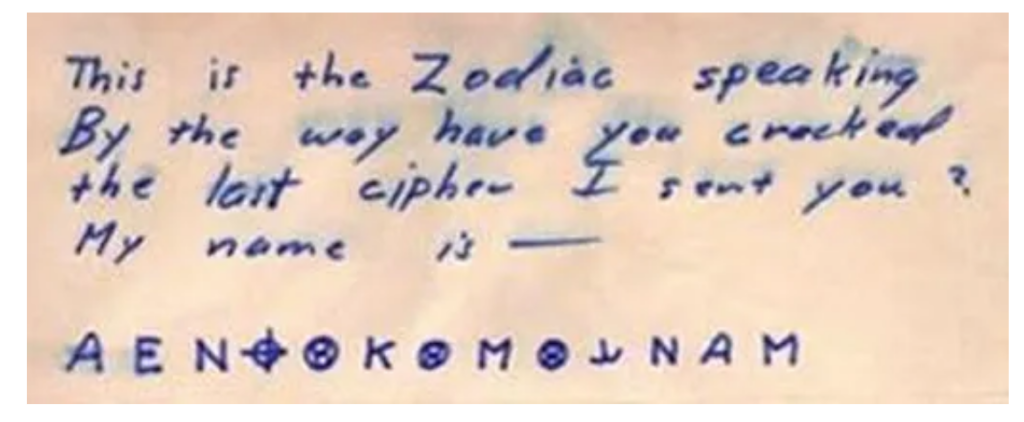
The Z13 cipher contains 13 symbols. Several of those symbols repeat in specific positions. That matters.
Because of those repeats, any valid solution must follow a fixed letter pattern if we treat the cipher the same way Zodiac’s solved ciphers work — one symbol equals one letter.
In plain English, any clean solution must obey these four rules:
• Letter 1 must equal Letter 12
• Letter 3 must equal Letter 11
• Letter 8 must equal Letter 13
• Letters 5, 7, and 9 must all be the same letter
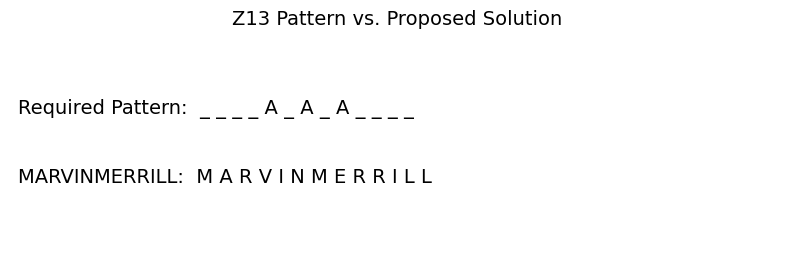
Think of it like a combination lock. If a proposed name doesn’t match this pattern, it is not a clean fit.
Put “MARVIN MERRILL” to the Test
Write it out: MARVINMERRILL
Steve:
I don’t fully agree with this critique. It seems to me quite likely the Z13 (and the Z32) are anagrams. The letters might be transposed randomly or according to some fixed scheme — it hardly matters in a short cipher. My eyes rolled when I heard the song-and-dance about military code-cracking, AI, and transposition schemes in relation to the MARVIN MERRILL solution. Uh, it’s an anagram with the right number of letters and repeats — end of story. I agree that the constraints set by the overall letter count and repeated symbol count are not very restrictive. That is especially true given: (a) any name can be spelled out in multiple forms, e.g., MARVIN MERRILL can be plausibly rendered as some variation of M[ARV[IN]] [S[KIPTON]] M[ERRILL], allowing multiple “shots on goal” — plus this guy had other names, and spaces might or might not be encoded; (b) there is a large universe of people and therefore names and name variants you could chose to build into credible suspects if you are not too particular about how you “enhance” the evidence (remodeling jawlines, adding glasses, etc.) Also, the inference that each symbol stands for a unique plaintext letter isn’t strong in this case as it seems reasonable the 8-ball symbol could be a wildcard, hinted at by the “Magic 8-Ball” association. So, we can’t have much confidence that the assumed constraints even apply.
If the short Zodiac ciphers have unique keys, then (most likely) they are not “fair play” in the sense that there is no realistic way to attack them as ciphers based on statistics, and hence no sport or kick in the game for the puzzle-poser. True, there might be some other clever clues hidden in the Zodiac letters to somehow make the game “sporting,” but I haven’t seen any credible theories on that score. Alternatively, if their solution comes through cracking the key to the Z340, the answers would be too easy and perhaps dangerously unambiguous unless the messages are scrambled — indeed, we would already have those solutions. My guess is the short ciphers are anagrams employing the key from the hard-but-crackable Z340. There might be additional minor wrinkles. In the Z13, the 8-ball is not in the known Z340 cypher alphabet, and perhaps it’s a true wild card. I believe there are one or two symbols in the Z32 (Celebrity Cypher) which are also outside the known Z340 alphabet. If this is right, the Z13 and Z32 have been rendered tractable but still tough — and probably forever ambiguous — now that the Z340 has finally been cracked. The best hope of solving the anagrams would be to consider who the Zodiac might plausibly be, and the unacknowledged crimes he might plausibly have committed. That part of the “MARVIN MERRILL” hoopla I can agree with.
-LW
Correction: The Z32 is the Mt. Diablo Code cipher, Z63 is the Celebrity Cipher. Anyway, same reasoning applies.
LW — I always appreciate your thoughtful take. I agree the short Zodiac ciphers leave plenty of room for interpretation, and ambiguity may well have been part of the design. Cipher analysis is not really my wheelhouse. I tend to view this as I do psychology — multi-directional, open to multiple interpretations. As always, I value your continued work on the puzzle side of the equation.
Luigi – The reason why the symbols dont match between each other – he used an arabic parent with a different offshoot – like one is Hindii and the z340 is Tamil. They arent anagrams. Drag and drop z13 for example into google trans, set language to Hindii press enter. These are really cryptolinguistics and his is Zodiac prior job description: He was a crypto linguist ( Cryptologic Linguists (or Cryptolinguists) are specialized military intelligence professionals who analyze, translate, and interpret foreign language communications to provide actionable intelligence. They identify foreign signals, break cultural codes, and monitor communications to support national security, often operating in airborne or ground-based roles) For you to solve z13 and z32 takes just 5 min. What zodiac did is make up what you see – the random symbols and letters (known only in Zodiacs head) this is exactly why the puzzles cant be decrypted. Somehow he has linked the actual language he used to those garbage char, IDK how !! And there is no key, and z13 has 39 char really, there are two more puzzles embedded. Z340 has 16 lines unsolved, with in it- is his real name. This one, is the most informative of all. Z13 and z32 both contain worthless phrases. Anyway Oranchak is now using my methodology, In z13 the 8’s are spaces, while z32 had embedded line feeds. 2 of them. Hope you dont mind my tacking on, there is no name in z13 – there is no bomb information in z32. There are no ciphers there. And where his real name was – last is in z340 and full was in z408
Tamil is a Dravidian language and Hindi is an Indo-European language family. Two different language families. Tamil is not an off shoot language of Hindi like Bengali would be an off shoot language of Hindi.
There are just three steps you need to follow to solve all ciphers. And they arent ciphers they are cryptolinguistics. Zodiac was a CTI in the Navy stationed in the middle east. Discovered what you see is random symbols and letters Zodiac made up and they disguise the arabic script which is what these are. Zodiac was fluent in arabic. The steps to solve them all is 1) you copy that word or sentence by drag and drop into google trans, 2) you set language to Hindii for z13 only 3) now press enter. They are just other languages you need to translate. Seems public and media mostly believe those are ciphers, they arent. z13 says glasses male me in Hindii Z32 says solar enkman emperor of japan in Telugu, Z340 is too ling to tell you here, but is it Telugu and last name is here. Z408 is Tamil, and it has Zodiac full name 1) Times – first name 2) Chronicle – middle 3) last one – last name. This is absolutely the truth. I dont make things up like some. Steve, all will come out in the wash. He will be proven wrong, because he is simply wrong.
I should tell you z13 and z32 DO NOT have 13 char. ACA and cryptological community is all incorrect. There are 39 characters instead is actually correct. They are 3 in 1 puzzles, not cryptology either. You get your first answer, I will use z13 as example, your answer to 1st one is glasses male me. The answer is many to one. Now you manipulate your languge and solve again, this time Zodiac tells you what letters to change for iteration 3 – It is iteration 3 that you want. Same with z32 but that one is a diff language. Zodiac as a CTI in the middle east was proficient in the arabic language. I should also tell you that A. B. mentor is Jaime Gomez of the Buddhafield cult. He has said he or Alex are available for interviews or podcasts for 125.00. See: Leader of a 1980s West Hollywood brainwashing cult, The Buddhafield, and the central subject of the Will Allen documentary, Holy Hell (2016), in which was revealed that he had sexually abused many of his male followers and psychologically abused many of the members. He is said to be in hiding in Hawaii with a whole new group. I wonder how much was brainwashing ? Its definitely a ruse to gain $$$
I think you have the Jaime Gomez confused with the actor who is connected with Baber. https://www.prlog.org/13063305-breaking-aiassisted-decryption-of-zodiacs-13-character-cipher-uncovers-groundbreaking-new-eviden.html
steve
Yes, I had it confused, they kind of look like each other. Thank you for pointing it out.
I read today in the news that it is also claimed now that z18 was also partially cracked and contained information about MM and BD. Well that is just not true either. Z18 says “something is hidden’ – its cult afrikaans, not used anymore or rarely by specific subgroups. He is referencing his name in z408. That was also not solved by Hardens for the identity. His full name is in z408.
Sorry but you are assuming Zodiac used a simple transposition 1-to-1 cipher based on the same alphabet for all messages. In the 60s he would have already had access to enough encryption methods beyond that; and/or he may have simply devised an anagram or stupid puzzle of the cleartext and given the column/row value of the cleartext based on some lookup logic into the coding alphabet he was using. He may have used different alphabets as well.
Too many of the ‘pundits’ out there assume so many basic ‘facts’ when in reality the possibilities are many more.
And, to be clear I don’t believe that the Zodiac’s messages have been decoded by anyone. Yet.