Retired LAPD Cold Case Detectives and “Team Connelly” Agree With Steve Hodel Investigation: Black Dahlia and Zodiac Were the Same Killer — But Disagree on Identity
By Steve Hodel/January 15, 2026
Birch Bay, Washington
79th Anniversary of Elizabeth “Black Dahlia” Murder
Historic consensus reached on linkage between America’s two most notorious serial-murder cases; dispute now centers solely on identity.
PRESS NOTE — January 15, 2026
(For Readers and Press)
“Team Connelly” refers to popular mystery writer and television producer, Michael Connelly and retired LAPD Cold Case and homicide detectives Rick Jackson and Mitzi Roberts, longtime law-enforcement consultants to Connelly’s television series Bosch and Ballard, the latter inspired by Detective Roberts’s LAPD career.
Over the past twenty-three years, media coverage of my investigations into the Black Dahlia, Los Angeles Lone Woman murders, and Zodiac crimes has routinely referred to my findings as “Detective Steve Hodel’s theories.” Let me be perfectly clear: these are not my theories, nor have they ever been.
I did not invent my father’s confessions. Those confessions exist in the Secret Los Angeles District Attorney Black Dahlia Hodel Files, recorded in 1950 and concealed in the DA vault for decades. I merely uncovered and reproduced the hidden transcripts.
I did not theorize that senior law-enforcement officials solved the Dahlia murder. I located, interviewed, and documented the statements of surviving family members confirming that Chief William H. Parker, Chief of Detectives Thad Brown, Undersheriff James Downey, and Deputy District Attorney Lt. Frank Jemison each separately identified the actual killer and had “solved” the case, based on their original investigation.
Nor did I speculate about the relationship between victim and suspect. District Attorney documents written in 1950 confirm that George Hill Hodel knew both Elizabeth Short and Los Angeles Lone Woman murder victim Louise Springer prior to their murders. That fact was known to law enforcement and establised in June, 1947, when both George Hodel and the police undercover informant were taken in and “grilled” by LAPD, more than six months before the murder of Elizabeth Short.
In Most Evil (Dutton, 2009), I presented a strong circumstantial case as him being “Zodiac” and formally requested that Dr. George Hill Hodel be placed at the top of the suspect list, and that San Francisco and Bay Area Police and or the CA Department of Justice obtained confirmed DNA and compare it to George Hodel’s full DNA profile as published in that volume.
By Most Evil II (Rare Bird Books, 2015), additional behavioral, forensic, and documentary evidence—along with thirty-two unique and highly specific crime-signature matches—allowed me to conclude that the Black Dahlia and Zodiac crimes were the work of the same offender. That conclusion was further reinforced when a Zodiac Ogham cipher was solved by French high-school teacher Yves Person, in which Zodiac actually spelled out his own name–HODEL.
What follows is a verbatim reprinting of those original thirty-two Black Dahlia Avenger / Zodiac M.O. crime-signature comparisons, first published in 2015.
While a small number of these crime-signature elements, viewed in isolation, could be considered generic, their combined presence is extraordinarily rare.
Black Dahlia Avenger / Zodiac
M.O. Crime-Signature Comparisons (32 Matches)
| M.O. Crime-Signature Behavior | Avenger | Zodiac |
|---|---|---|
Serial killer | ✔ | ✔ |
Created his own marketing / public-relations campaign; invented and supplied the press with a pseudonym for headline use (“Black Dahlia Avenger” / “Zodiac”) | ✔ | ✔ |
Contacted and taunted the press by telephone after crimes | ✔ | ✔ |
Contacted and taunted police by telephone after crimes | ✔ | ✔ |
Used the press as his instrument of terror, promising “There will be more” | ✔ | ✔ |
Drew a crude picture of a knife dripping blood and mailed the drawing to the press | ✔ | ✔ |
Brought pre-cut lengths of clothesline and used them to bind and tie victims | ✔ | ✔ |
Mailed more than a dozen notes to police and press feigning illiteracy, using misspelled words and disguising handwriting | ✔ | ✔ |
Mailed “cut-and-paste” notes to press and police | ✔ | ✔ |
Mailed a typewritten letter describing his actions to police | ✔ | ✔ |
Placed excessive postage and multiple stamps on taunting notes mailed to press / police | ✔ | ✔ |
Addressed press mailings “To the Editor” | ✔ | ✔ |
Sent mailings on specific anniversary dates related to crimes | ✔ | ✔ |
Packaged and mailed personal items belonging to murdered victims to the press to prove authorship of the crimes | ✔ | ✔ |
Told victims and the press that he was “Going to Mexico” | ✔ | ✔ |
Used both a knife and a gun (or guns) in separate crimes | ✔ | ✔ |
Included puns and word-games in mailed communications | ✔ | ✔ |
Continued sending mailings to press and police months and years after the original crimes | ✔ | ✔ |
Egomaniacal personality demanding constant media publicity and front-page coverage under threat of additional killings | ✔ | ✔ |
Identified himself as an “Avenger,” claiming he had been wronged by the female victim; portrayed murders as justified or “Divine Retribution” | ✔ | ✔ |
Several victims stabbed with a long-bladed jungle K-Bar or bayonet-style knife | ✔ | ✔ |
Wrote taunting messages at or near the crime scene (wall, telephone post, vehicle panel, or on the victim’s body) | ✔ | ✔ |
Manually ripped away the band from a man’s wristwatch and left band and watch at separate crime scenes | ✔ | ✔ |
Left a man’s white handkerchief at the crime scene, or used it to wipe fingerprints from a vehicle or knife | ✔ | ✔ |
Geographically pre-selected crime-scene locations by plotting coordinates on a map, then randomly murdered victims entering the “killing zone” | ✔ | ✔ |
Geographically pre-selected crime-scene locations and had an unwitting victim (taxi driver) transport him there, then murdered the victim | ✔ | ✔ |
Forcibly kidnapped female victims, strangled them to death, dismembered bodies with surgical skill, and posed body parts in public locations as taunts | ✔ | ✔ |
Extreme overkill and savage brutality, particularly toward female victims | ✔ | ✔ |
Telephoned or mailed sadistic communications to victims’ parents after the murder | ✔ | ✔ |
Signed taunting letters to the press as “a friend” (lower-case “a”) | ✔ | ✔ |
Mailed “a friend” correspondence on a specific crime-anniversary date | ✔ | ✔ |
Used murder as symbolic communication involving art, culture, language, and staged presentation |
During my twenty-four years with the LAPD, I investigated more than three hundred homicides. None involved a perpetrator who mailed taunting notes to the press or police, threatened future killings, or contacted victims’ families—with one exception.
Prior to the Zodiac’s 1966 Riverside murder, I am unable to identify a single modern American serial killer who employed this precise and obsessive pattern of press and police taunting through deliberately misspelled letters—again, with one exception: Dr. George Hill Hodel, who in the 1940s called himself the “Black Dahlia Avenger.” Before that, investigators must go back nearly sixty years—to 1888 London and Jack the Ripper.
In previous investigative summaries in Black Dahlia Avenger, Black Dahlia Avenger II, and Most Evil I, I have detailed additional links involving handwriting characteristics, as well as the killer’s consistent use of surrealist references drawn from art, literature, music, and film.
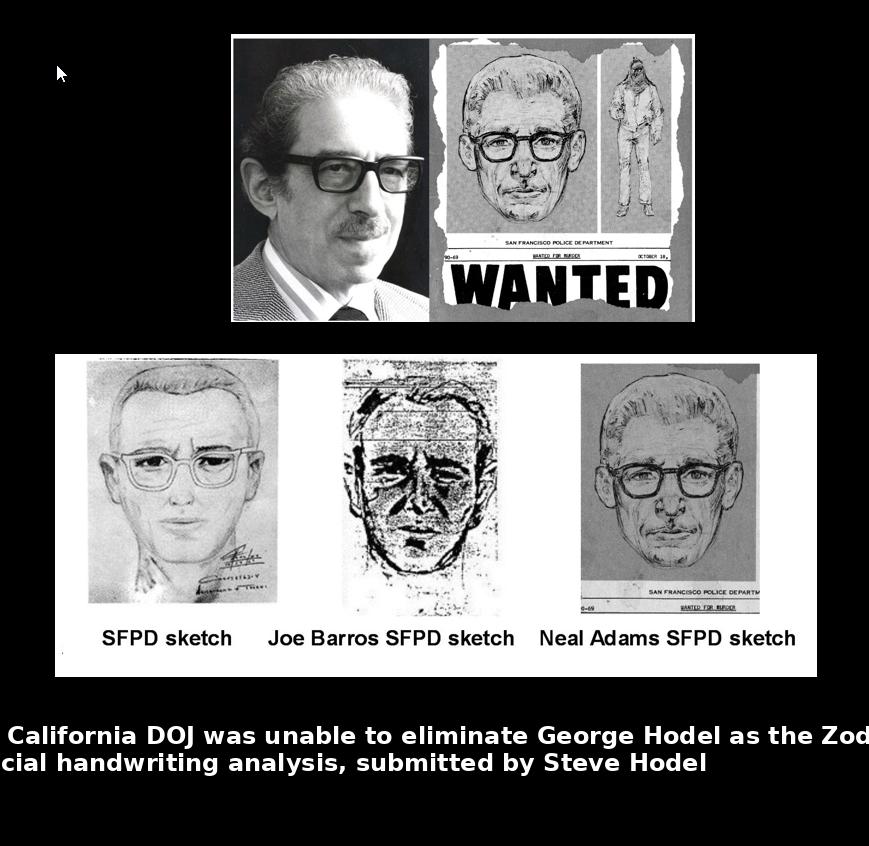
In 2010, a California Department of Justice handwriting expert compared known handwriting samples from George Hodel with verified Zodiac letters. While unable to reach a court-level identification, the examiner concluded: “We are unable to eliminate George Hodel as the writer of the Zodiac letters.” At that time, DOJ requested additional lower-case handwriting samples, which remain unavailable.
As stated in Most Evil:
George Hodel was a prolific serial killer whose signature is visible not in any single method of murder, type of victim, or specific killing ground, but rather as a series of complex arrangements, installations, and obscure references to art, culture, and film which, taken together, reveal a chilling and never-before-documented form of serial murder—murder as a fine art.
One additional crime-signature element—unrecognized until recently—further links the Avenger and Zodiac. In taunting letters mailed decades apart, both signed identical correspondence to newspaper editors as “a friend,” using a distinctive lower-case “a.”
The Zodiac’s February 14, 1974 “a friend” SLA letter was mailed on the twenty-sixth anniversary of the Black Dahlia Avenger’s February 14, 1948 murder of Los Angeles victim Gladys Kern. This was not coincidence.
As Michael Connelly’s LAPD Detective III Harry Bosch famously observed:
“There are no coincidences.”
Always fascinated by this homicide and had a friend who was a patient of Dr Hodel and given the wrong diagnosis. Excellent books with much evidence and totally undeniable theory as to Dahlia’s killer. If you are a fan of True Crime stories, you must read these books!
Carol K:
Thanks for the kind words. Much appreciated. And, yes, the “misdiagnosis” and extra billing of patients was part of George Hodel’s
regular practice at his First Street Clinic. Best, Steve
Steve, wasn’t it Eric Zelms, SFPD who volunteered to sit with the artist who rendered the first drawing of GHH after the cab driver Paul Stine’s murder in San Francisco? Zelms said he could add more to improve on the original drawing done by the artist rendering for the SFPD. Arrangement for the additional sitting was made but Zelms was killed while on police duty before meeting with the SFPD artist. It’s been awhile since I read the account of cab driver Paul Stine’s & Eric Zelms deaths but do remember Zelms death left a young wife & young child. So many victims and so much tragedy resulted from GHH’s tremendous anger & hatred for his fellow man which unfortunately obliterated his high intelligence for doing good. His murders & guilt need to be exposed & used in educating medical, educational and Law Enforcement agencies worldwide!! The withholding of truth here adds tremendously to the heinous nature of George Hodel’s murders and his “hold” over so many people/agencies to squash that truth for so many years!!
Patricia O:
Not sure about Zelms and redo of composite. Could have been, just don’t recall reading it. His partner Foukes laid low until he was called out by Zodiac in the mailing to the press and mentioning the “two cops stopped me….” Then he had to fess up a month later after the shooting. Then his partner killed eight weeks later and then he was home free to claim, “Never stopped and talked to him, just drove by him..” But, Zelms wife knew the truth and said so. Stand by, one more surprise coming up fairly soon.
Be well. Steve
Standing by for that surprise Steve👍🤗!!
You stay well too…..breathing salty ocean air once again is wonderful 😎!!