A Most Curiouser and Curiouser Find in an Old Poe Book
A Most Curiouser and Curiouser Find in an Old Poe Book
Do I Hear the Gods Laughing?
November 14, 2025
Birch Bay, Washington

The worn cover of the century-old Poe volume — a book that has clearly lived many lives
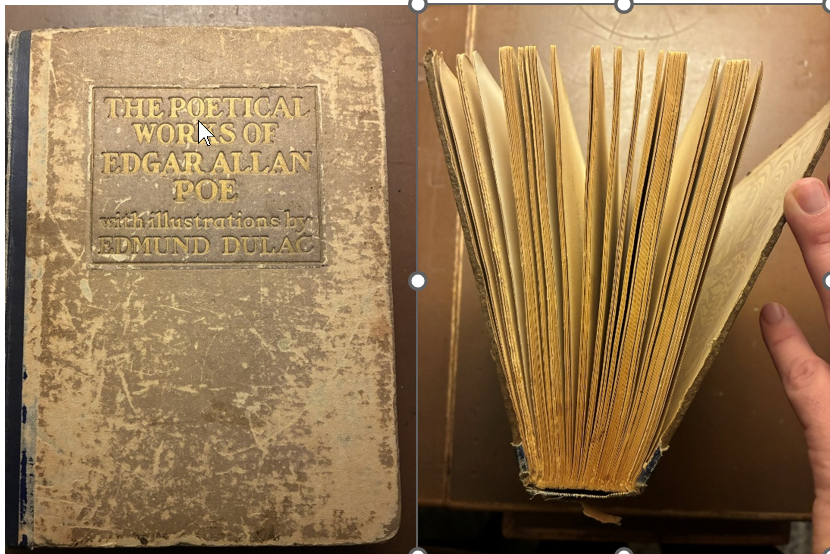
Every so often, something surfaces in my investigations that feels less like evidence and more like a wink from the universe. This week it arrived in the form of an email, a photo showing a well-worn, century-old volume of The Poetical Works of Edgar Allan Poe, illustrated by Edmund Dulac.
A reader named X had purchased the book. When he opened it, he discovered a handwritten inscription spread across two pages — emotional, poetic, and unmistakably early‑1920s in tone. He reached out to ask if the inscriber, “George Hill Hodel,” might be my father.
This rare volume may well contain an early George Hill Hodel inscription.
I began reading.
And the story grew curiouser and curiouser.
The Inscription
And then came the real surprise: the inscription.
Two full pages written in flowing script, addressed to a woman named Milicent. Romantic, ornate, dramatic — exactly the sort of private performance young George often indulged in during the 1920s.
Before going deeper into the rabbit hole, let’s revisit what drama critic Ted Le Berthon wrote about young George and his self‑published magazine, Fantasia, in a 1925 Los Angeles Evening Herald article. (Le Berthon changed the name of the magazine to Whirlpools and young George’s name to George Morel.)
Los Angeles Evening Herald — December 9, 1925
THE MERRY-GO-ROUND
By TED LE BERTHON
The Clouded Past of a Poet
GEORGE MOREL is tall, olive-skinned with wavy black hair and a strong bold nose. His eyes are large, brown, somnolent. A romantic, hawklike fellow, a pianist, a poet, and editor of Whirlpools, a bizarre, darkly poetical quarterly.
“George is a nice boy but—”
How often did one hear that!
What his friends hinted was that George, being young, was inclined to write of melancholy things.
Of course, George could have pointed to Keats, Rupert Brooke or Stephen Crane for precedent, but—“It’s not George’s gloom, his preference for Huysmanns, De Gourmont, Poe, Baudelaire, Verlaine and Hecht that pains us,” these “friends” would parry, “but his stilted elegance, his meticulous speech!”
George drowned himself at times in an ocean of deep dreams. Only part of him seemed present.
He would muse standing before one in a black, flowered dressing gown lined with scarlet silk, oblivious to one’s presence.
Suddenly, though, his eyes would flare up like signal lights and he would say, “The formless fastidiousness of perfumes in a seventeenth‑century boudoir is comparable to my mind in the presence of twilight.”
One might have answered “What of it?”—but one just didn’t.
As one of George’s “friends” put it: “He’s young. He’ll get over it. What he needs is contact with harsh realities. At present his writing is tenuous, dreamy, monotonous — and he is like his writing.”
A Future Realistic Novelist
I hadn’t seen George for about a year —
And last night, strolling up Spring Street in a sort of Morelian reverie myself, I was startled by hearing a familiar voice. The next moment I saw a tall young fellow in a taxi driver’s uniform seize a burly, argumentative man by the coat lapels and growl menacingly:
“Come across with that taxi fare or I’ll smack you in the nose, right here and now!”
The speaker was GEORGE MOREL.
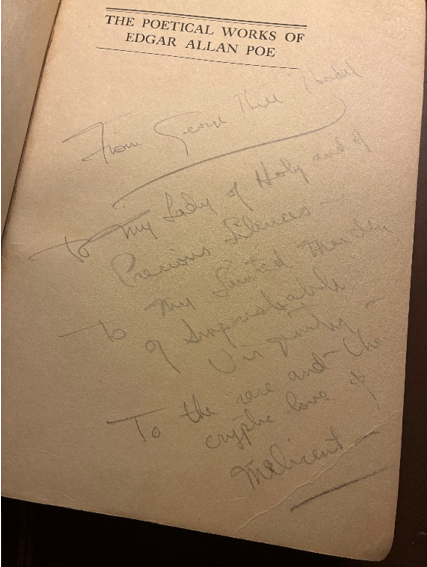
Back into the Rabbit Hole — and an early major thoughtprint. This appears to be an early George Hill Hodel inscription hidden inside the Poe volume.

The first half of the inscription — poetic and emotional.

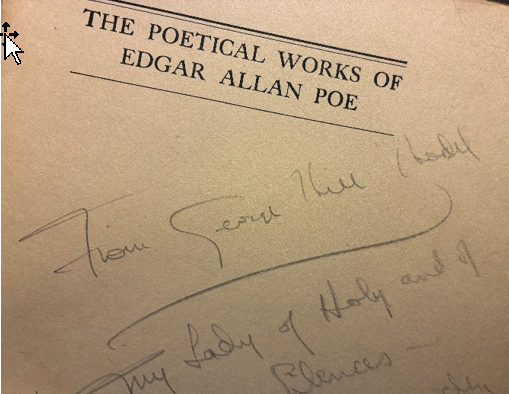
A closer view of the dedication line: “From George Hill Hodel.”

The inscription continues across the facing page, ending with a date.
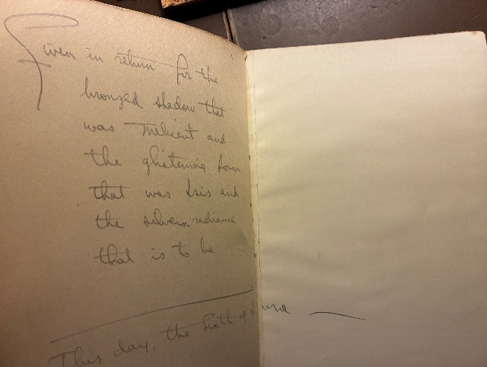
Full Transcription of the Inscription
From George Hill Hodel
To my Lady of Holy and
Precious Silences —
To my limited marvels
of improbabilities —
In poetry —
To the rare and
cryptic love of
Millicent
Given in return for the
bronzed shadow that
was Milicent and
the glistening form
that was his and
the silver radiance
that is to be.
This day, the Fourth of June
Romantic? Yes.
Overwritten? Certainly.
But entirely of its time — and entirely in character for George Hill Hodel as described in Ted Le Berthon’s 1925 article. This George Hill Hodel inscription provides a revealing early thoughtprint. This George Hill Hodel inscription is an early psychological and stylistic thoughtprint.
In his emails, X went on to inform me that several of the illustrations had been cut and repasted elsewhere in the book. Several plates had been moved, removed, or cleanly reattached. X wrote that “whoever handled them did so carefully — very skillfully.” A curious detail, and one rarely seen in surviving copies.
The Dulac Illustration

One of Edmund Dulac’s dreamlike illustrations — ethereal figures suspended between sleep and enchantment.
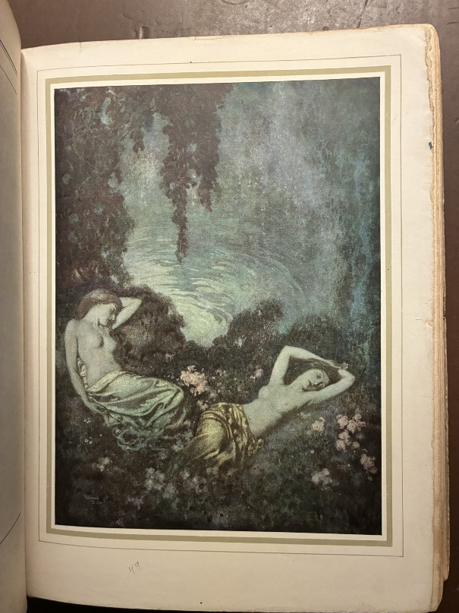
Steve:
Eerie find on the “Minotaur” semi-nude.
Consider: “To my Lady of Holy and of Precious Silences” vs. “St. Donna & Guardian of the Pines.” Who talks like that? Not many people, that’s for sure.
-LW
LW:
For sure, for sure.
Steve:
Looking at the inscription more closely, I believe “Milicent” is actually “Melicent,” an even rarer variation on “Millicent.” I searched for possible literary/mythical/historical antecedents, on the basis “Melicent,” like the goddess Isis (also referenced), is some kind of poetic allusion or pet name (like “Dorero”), rather than the real name of the dedicatee.
I think it probable that GHH’s use of “Melicent” derives from James Branch Cabell’s 1913 novel, “The Soul of Melicent,” which was republished as “Domnei: A Comedy of Woman-Worship” in 1920. The high-flown, chivalric language and the theme of two men battling to win one pure maiden seem a propos. There are not a lot of Melicents out there, even in literature, and Cabell’s book seems like the easily the best fit from what I turned up.
Cabell was a very widely-read and esteemed writer in the 1920s. He influenced many famous fantasy writers, even after he went out of literary fashion. Matt Weinstock’s obituary for GHH’s pistol-packing, tight-with-Tony Cornero, Teresa Mors scoop-scoring crime reporter colleague on the LA Record, Johnny Arrington, mentions that he was a fan of both James Branch Cabell and Remy de Gourmont (another GHH favorite). Probably gave them a lot to talk about.
-LW
The Cabells are an old, affluent and well-connected Virginia-based family, two of whom were Dallas brothers Earle and Charles, seemingly involved in the JFK Bay of Pigs thing.
What a synchronicity! That someone found a book with your father‘s inscription and MORE women in the Minotaur pose. So uncanny.
I’ve been reading your blog since the beginning and check in every six months or so to see what’s new. There is always something astonishing. I hope you are enjoying your life in the Pacific Northwest!
Emily: Thanks. Yes, enjoying my move to Birch Bay, WA and finding my new bestie beastie, Rima. She gives me lots of licks and is a great companion. Best, Steve/
Hi. Steve,
This inscription is also a rare case of GHH writing totally in cursive instead of lettering.
The top of the T is often long, topping the T in the next word and ending with another letter.
This reminds me of the handwriting expert who commented on the genius in such handwriting, particularly in how he wrote “Steven”. This letter takes to a whole new level..
I enjoyed L.W. ‘s comment… “Who talks like that? Not many people. That’s for sure.”.
Best Regards,
Dan