Setting the Record Straight: Black Dahlia, Zodiac and the Historical Timeline
February 6, 2026
Birch Bay, Washington
A brief clarification of the Dahlia–Zodiac linkage, LAPD investigative findings, and forthcoming evidence inAs Within So Without.
Over the past few months there’s been a surge of media attention around a new claim that the Black Dahlia murder and the Zodiac killings were committed by the same person. Much of that attention has focused on a newly proposed suspect and the support of several well-known voices.
I’ve stayed mostly silent. Not because I don’t have an opinion, but because in homicide work—and in history—the noise usually settles on its own. Still, when the public story starts moving faster than the factual timeline, it’s time to quietly set a few things straight.
This Link Wasn’t Born Yesterday
The idea that the 1947 murder of Elizabeth Short and the Zodiac crimes might be connected didn’t begin with the current headlines.
I first laid out the forensic and behavioral basis for that possibility in my book Most Evil back in 2009. Six years later, in Most Evil II (2015), I expanded that work and documented 32 specific crime-signature parallels between the two case histories.
Investigators can disagree—and often do—about the final suspect. That’s nothing new in cold cases. But the published existence of the linkage itself, years before today’s publicity, isn’t a matter of opinion. It’s part of the record.
What Happened Behind the Scenes
Between 2022 and early 2023, I had extended professional communication with Alex Baber, who at the time expressed strong support for my investigation and its conclusions. During that period, he requested and I shared a substantial portion of my investigative archive with him—decades of research, official reports, supporting documents, and the full body of my published work (seven books) on the Black Dahlia case, Zodiac, and related homicides. Our correspondence ultimately totaled more than one hundred emails.
After that exchange, communication stopped.
Nearly two years later came the public announcement of what was described as a newly discovered solution linking the Black Dahlia and Zodiac crimes under a different suspect identity, accompanied by significant media attention and the public support of Michael Connelly and several retired Los Angeles Police Department detectives associated with his work.
I’m not here to argue motive or intent. That’s not my style, and it isn’t necessary.
But timeline matters, and chronology is part of the historical record.
Two Separate Questions
What’s getting blurred in the current coverage are two very different questions:
Are the Black Dahlia and Zodiac crimes connected?
And if they are, who committed them?
Those are not the same issue.
The first question is about forensic behavior, signatures, and documented patterns.
The second is about proving a specific suspect.
My work over the past two decades has addressed both, but the linkage analysis stands on its own, regardless of which name anyone places at the top of a suspect list today.
And if a newly proposed suspect theory eventually falls apart—as many historically have—the failure of that theory should not erase the underlying evidence that first raised the question of connection.
How These Cases Move Through History
High-profile murder cases tend to move in waves.
Every few years, a new “final answer” captures public attention.
Then time and evidence do what they always do—they sort things out.
Publicity fades.
Documentation remains.
That’s the only reason for this note: to make sure the chronology stays clear for anyone who cares about the truth of these cases and the memory of the victims.
One Thing That Has Changed
For years, the question was whether the Black Dahlia and Zodiac crimes could even be related.
Now the debate has shifted to who the killer might be.
That change didn’t happen overnight.
It grew out of years of published investigative work placing the linkage itself into the public record.
Where future evidence ultimately leads is something only time—and perhaps DNA—will answer.
But the origin of the linkage, and the path it took to reach today’s conversation, are already matters of fact.
And facts, in the end, are what solve cases.
Or at least keep the truth alive until they do.
P.S.
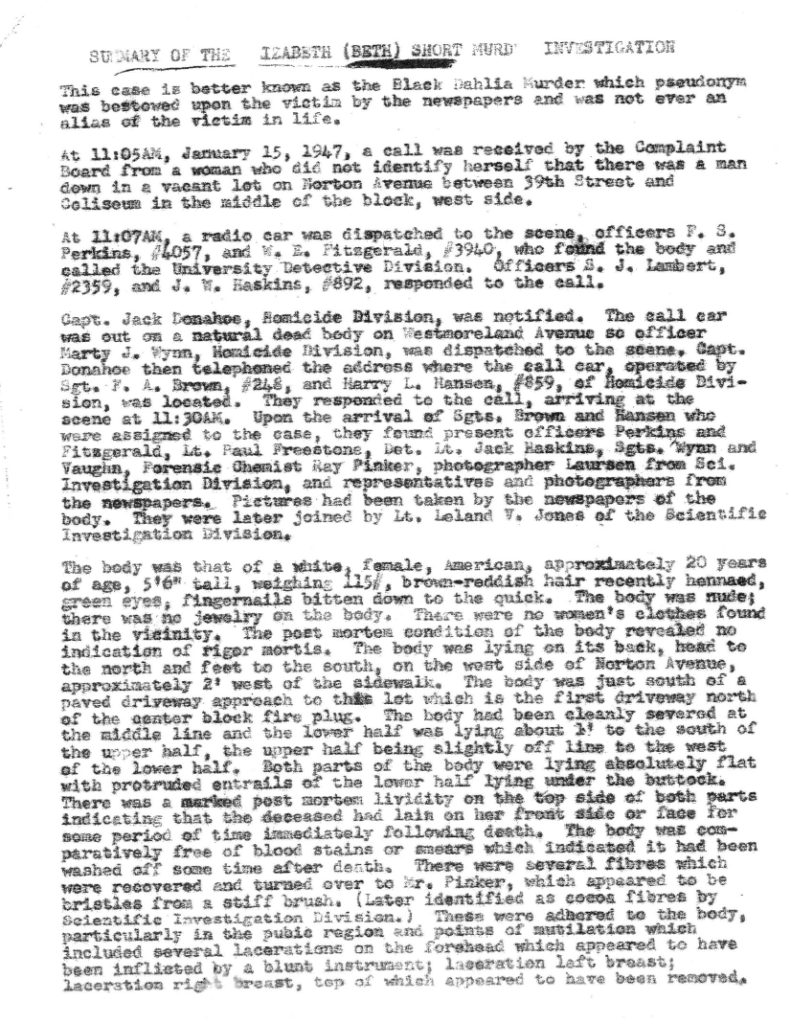
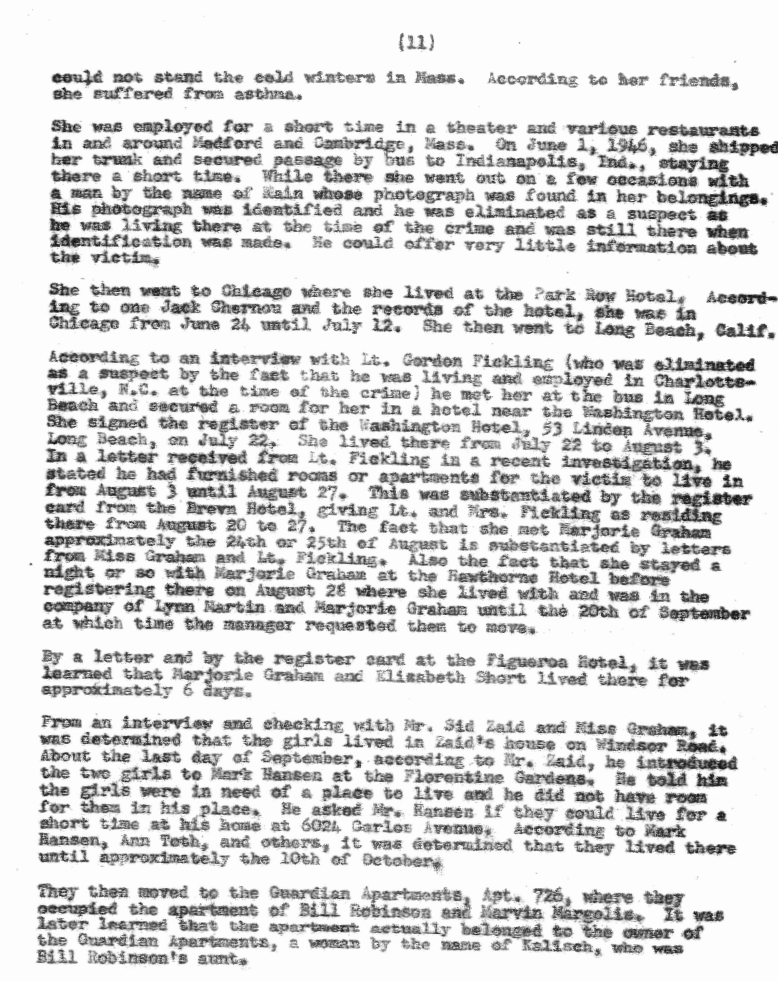
For readers seeking completeness of the public record, I am including an official Los Angeles Police Department summary of the Elizabeth Short investigation. (Original 1950 LAPD document attached below)
Within that report, LAPD recorded:
“An investigation was made which eliminated them as suspects due to their work and where they were during the time the victim was missing.”
The individuals referenced in that finding were Marvin Margolis and Bill Robinson, as reflected in the same investigative summary. The document itself speaks more clearly than any modern commentary.
I would also note that my investigation has continued to develop. With the forthcoming publication of As Within So Without: Man Ray, Surrealism and the Secrets Behind the Black Dahlia Murder, expected within the coming week, additional material will enter the historical record, including the Jane Doe imagery and the acknowledged Man Ray/Copley “As Within As Without” works—artifacts reflecting contemporaneous artistic knowledge consistent with conclusions I first reached through homicide investigation rather than art history.
That same work presents documented comparative analysis indicating a 97–99% probability that the Jane Doe depicted in the photograph taken by my father and presereved in his private album, is Elizabeth Short, along with forensic image assessment suggesting a high probability that the subject was either unconscious or deceased at the time the photograph was created—findings that directly align with and reinforce District Attorney records establishing that “Short and Dr. George Hodel were in fact acquainted prior to her murder.”
As always, I will allow the documented record—not headlines or passing theories—to determine where the truth ultimately settles.
— Steve Hodel
1950 LAPD Black Dahlia Investigative Summary: pages 1, 11,12.
page 11
Page 12
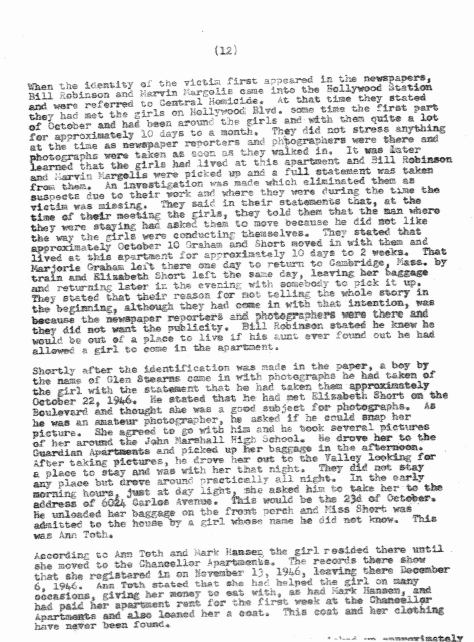
P.P.S: Per the original LAPD summary it should be noted that both Marvin Margolis and Bill Robinson, after learning of the identity of the Jane Doe#1 victim as being Elizabeth Short both, voluntarily, on their own, went to Hollywood Police Station, to give a statement and were referred to Central Homicide where they informed officers they knew the victim and her girlfriend, and the two women stayed with them for ten days at their Hollywood Blvd., apartment. LAPD in this report cleared both Margolis and Robinson based on time schedules indicating they could not have committed the murder.
This stinks. Plagiarism, chicanery, and repackaging for what? Clicks? A few bucks?
Not justice.
💩🐦🐦 get exposed.
Steve: What a scam. Figured something was up from the smoke and mirrors explanation of the “solution” to the Z13. And Connolly got played for a sucker. -LW
LW: Yep, also have to think there was a $$$$ factor in it for Connelly too with his episodes of podcasts. Shame. I have always been a big fan of Connelly and his books and Bosch/Lincoln Lawyer series. But, his closeness and friendship with LAPD now retired downtown Robbery/Homicide detectives and “Team Connelly” paid consultants Mitzi Roberts and Rick Jackson blinded him to the truth. Lot more to the story, and behind the scense BS, but will leave it at that for now.
Only you know the truth.
Bottom line, Steve: DNA!! This is never included nor spoken of in all investigations of these crimes with a connection to George Hill Hodel……glaring omissions in every pursuit of solving these crimes!! The “who” and the “why” are buried in decades of coverup🤐!!
Patricia O:
LAPD doesn’t have any and wont do any serious testing on potential envelopes and ignores possible connections on any of the other LA Lone Woman Murders from 1947. SFPD and other agencies apparently haven’t tested or won’t test their separate crimes together and Zodiac has no confirmed DNA due to lack of comparisons inter-agencies so nothing forthcoming. All their attitudes are the cases are too old, too cold.
But you, Steve, openly offered your father’s DNA several times if I recall. Same excuses…..”too busy with current cases”. Black Dahlia, Lone Woman Murders now ancient unsolved history, etc., etc. Unfortunately that silent treatment of murder encourages future predators and history repeats itself😨!
I’ve been researching Alex Baber’s claims and from interviews he’s done he had this Black Dahlia Zodiac theory going back publicly to at least 2020 and I suspect before even then. In his interviews he has had a series of partners and multiple crimes that have been the focus, but always he’s claimed the Zodiac Killer committed many many more crimes in various jurisdictions and only he knows the true extent because he’s some modern day Sherlock Holmes (accurately honestly because its all fiction).
In all those interviews I’ve watched and in all the articles I’ve read, NONE of them mentioned Hodel as a suspect. His baseline fact have stayed relatively consistent: 2 people did these crimes. One of them died in 93 one died in 2010, one called him in 2007 after he solved the z13 and posted the solution online.
I think Baber not only fabricated this entire theory of his, but also stole research from other people, and think that’s what he was doing here. In the beginning of the interviews I’ve found he was very focused on Lawrence Kane as a suspect for all these murders including the Atlanta Child Murders and the Oakland County Child Killings, and claimed Kane had a partner he called M. S., but then more recently he kind of dropped the explicit focus on Kane and now he’s saying it was Margolis. From what I’ve read from and about him, it seems he was in contact with various people regarding research and I think he was stealing that research, incorporating it into his theory, and shaping the theory as he went along. Because in the beginning he’d only mention Zodiac and Black Dahlia but wouldn’t really go into a lot of detail about those crimes, he’d focus on the Atlanta Child Murders and Wayne Williams and William Heirens and the Chicago Lipstick Murders, and had a friend or partner who was part of a Free Wayne Williams project. But then later he shifted from that into this more Zodiac Black Dahlia theory. I think that may be because he only had other people’s information about those cases and only more since 2022-23 was able to get enough of other people’s research to add it to his story about Kane and M. S., now Margolis.
Its really scummy of him to do that and should be crediting his sources, although I don’t think I’d want my research associated with him 😅 since his theory is nonsense and completely unbelievable in its totality. Of course he’s claiming he’s an auto didactic polymath afflicted with perceptionalism which caused him to be some kind of autistic super sleuth genius, so crediting other people just wouldn’t do. And I guess to be somewhat fair, a lot of his theory did come from his own imagination, although a lot of even the far out theories he’s claimed to have developed did in fact exist online already.
Hell – What z13 says is this – Glasses male me – this has been solved for a few years now, it contains nothing about BD or MM. How you determine this answer is that you drop into microsoft translator, you set language to Hindii, and press enter. Zodiac just lied and people believed it when he said they were ciphers. Zodiac served as a CTI in the Navy in the middle east. (INtel) all of the so called ciphers are really middle eastern languages you just translate. Z32 says solar enkman emperor of japan, and this one is Telugu. Z340 was Tamil, you have to do one sentence at a time on this one. Z13 and z32 take 10 min total to solve and z340 is a little longer – maybe 1/2 hour. Zodiac name was in z340 and z408. No, Alex was not correct in his solutions., It cannot be solved with AI or cryptology. Theres still 16 lines in z340 left to solve. NO match, no key, no cryptology, no BD no MM
I didnt mean to write Hell, I am sorry, I meant HI !!
Hi !! Z13 said glasses male me – it is HIndii, The so called ciphers are just other languages, and they come from the time Zodiac was a CTI (intel) in the middle eastern working with the arabic languges.
Drop into google translator, set language to hindii, press enter. Thats all that was necessary this whole time. Z32 says solar enkman emperor of japan and this is Telugu. Both together take 10 min to solve. Z340 – has his name in the last 16 unsolved lines. This one is Tamil, and you can do one sentence at a time. AB is incorrect, there is no way you can solve them with AI, 700 million names (its not even a name) cryptology (unless you want to take years and its iffy. Just translate !!!!! Zodiac name is also in z408. LE already has this information and was approved. No AB is not correct. Try it !!!
Steve, the viable dna was in Florida and he K### Connie Ballard and Richard Martin there, this was not known till they tested it. I know because the Zodiac task force sergeant for Brevard county sent me an email confirming this. They were suspicious it MIGHT be because the scene matched Berryessa.