The George Hodel “Jane Doe” Photograph: Can a High-Confidence (95–99%) AI Match to Elizabeth Short Be Reasonably Excluded?
December 17, 2025
Birch Bay, Washington
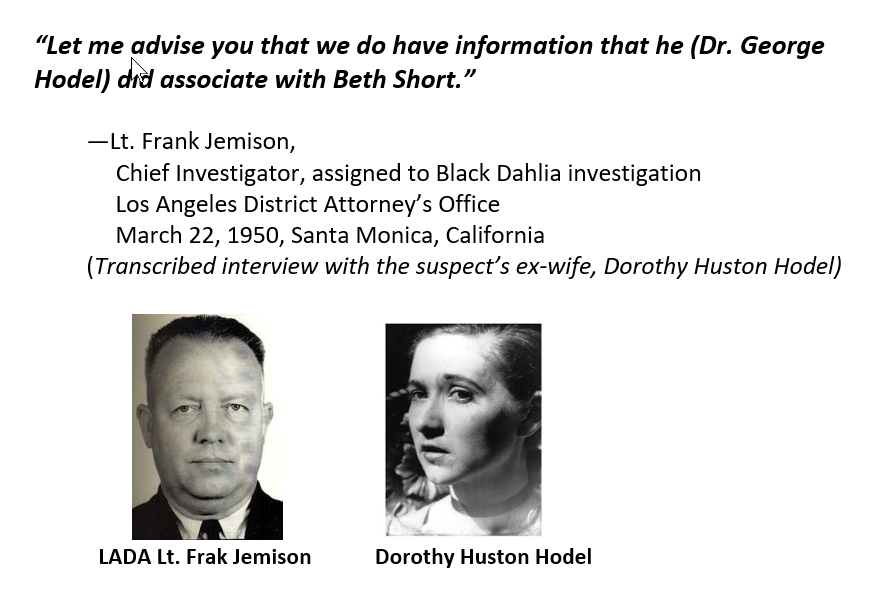
The George Hodel Photograph: Can It Reasonably Be Excluded?
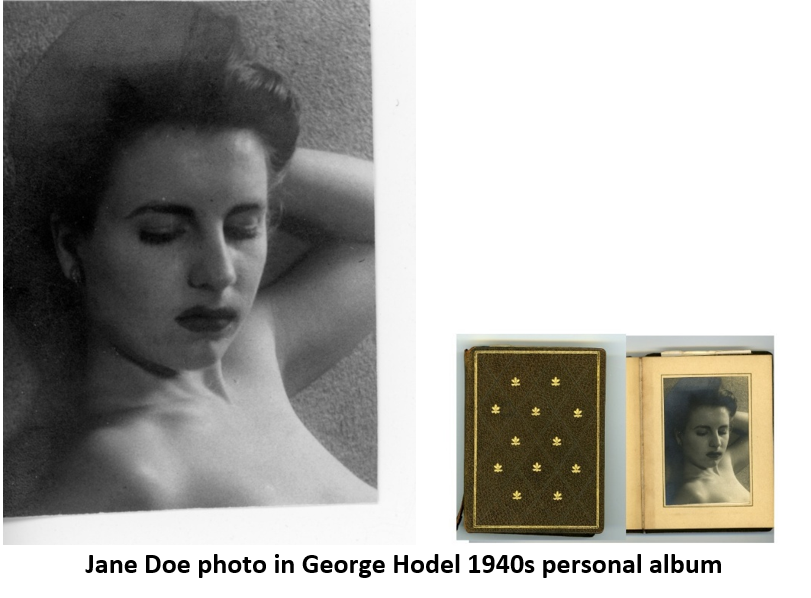
For more than two decades, a single photograph from the private album of Dr. George Hill Hodel has generated intense debate. Critics have been quick to declare, often reflexively, that the woman depicted is “obviously not Elizabeth Short.” Others insist the resemblance is “not even close.” These assertions are typically delivered with confidence—but rarely with analysis.
I’ve never asked anyone to accept the album photograph as definitively depicting Elizabeth Short. What I have asked, consistently, is a narrower and more appropriate question: can it reasonably be excluded?
The reason I continue to ask that question, more than twenty years after first publishing the image, is simple. The photograph has often been dismissed reflexively, sometimes in a sentence or two, without serious examination. I have never understood that response.
Early efforts to evaluate the photograph relied on facial-comparison techniques that, by today’s standards, were still in their infancy. Even so, the results were noteworthy. Not because they proved identity—they did not—but because they refused to go away. Different methods, applied at different times, kept landing in the same general range of similarity.
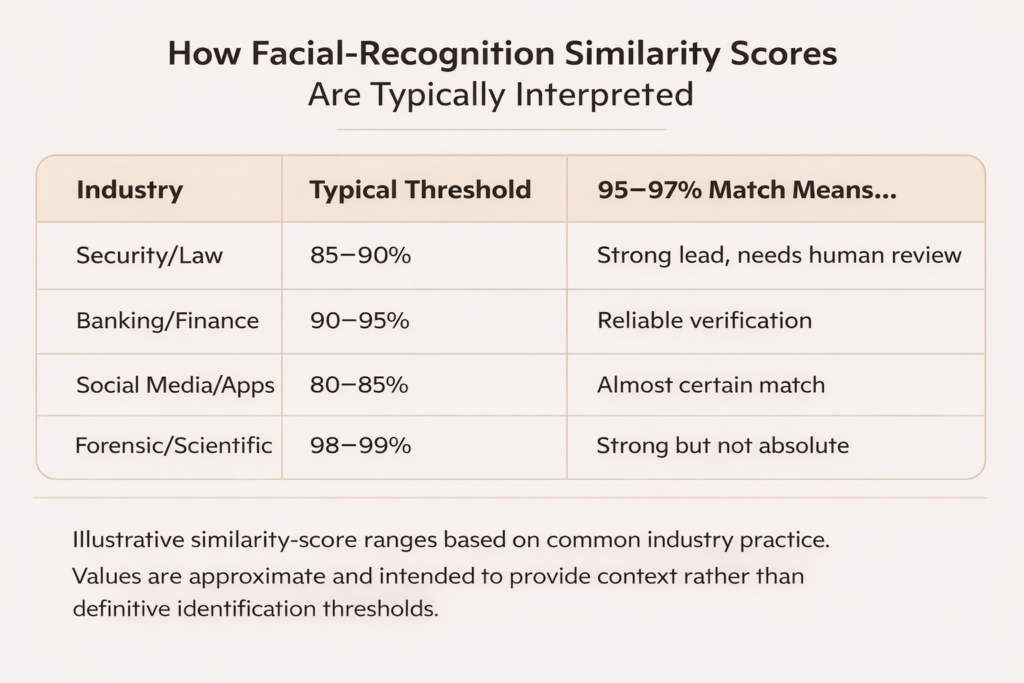
In facial-comparison analysis—particularly when working with mid‑20th‑century photographs—no reputable biometric methodology claims or produces a 100 percent positive identification. Variations in lighting, posing, facial expression, lens distortion, film grain, aging, and image degradation impose an upper ceiling on confidence scores. In practice, similarity scores above the mid‑90 percent range are uncommon even when comparing verified photographs of the same individual taken at different times.
More recently, independent readers applying modern AI-assisted facial comparison tools to the same album photograph have reported similarity scores in the high‑90 percent range when compared against authenticated images of Elizabeth Short. What struck me was not the number itself, but how closely those results echoed findings obtained years earlier using very different methods.
I am not asking anyone to accept the album photograph as Elizabeth Short. I am asking whether it can reasonably be excluded. When facial-comparison tools—applied across time, technology, and analysts—consistently place an image within the highest similarity range, dismissal becomes less a scientific judgment than a personal one. Interpretation is left to the reader; the evidence speaks for itself.
Over time, science—not speculation—has increasingly framed the answer.
The Photograph and Its Origins
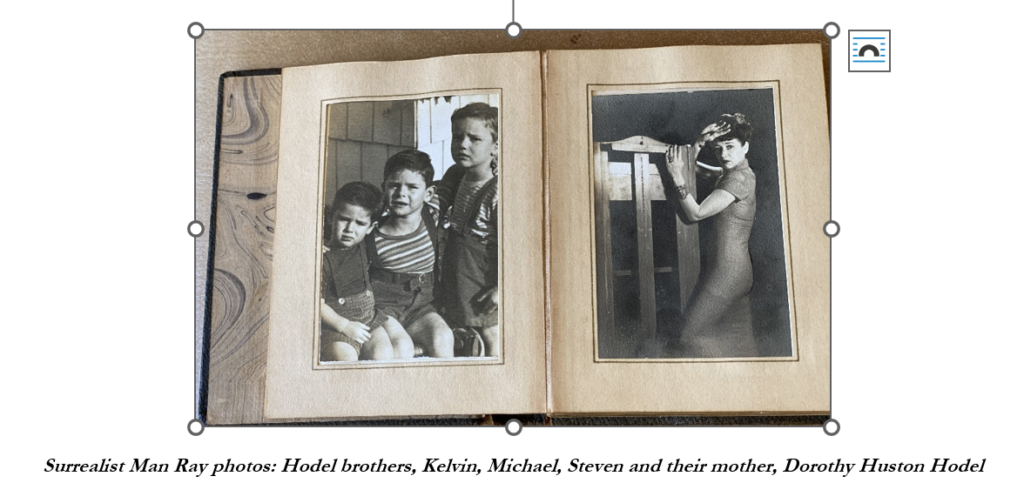
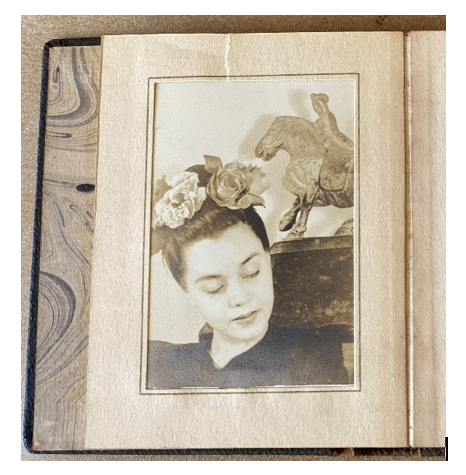
The image in question comes from a photograph album owned by my father, Dr. George Hodel during the 1940s. Its provenance is documented and uncontested: it was part of his personal effects, retained by his wife, June, and contained 1940s family photographs, along with some non-family members. June gave it to me just days after his death saying, “I think you’re father would have wanted you to have this.”
The photograph in question, (shown top of page) depicts a young woman in repose, eyes closed, with heavy lipstick applied beyond the natural lip line. The image is striking, unsettling, and unlike conventional portraits circa 1940s.
From the outset, reactions to it have tended toward extremes—either immediate rejection or uncritical acceptance. Neither approach is useful
Early Biometric Analysis
In November 2013. Some ten-years after the publication of my first book, Black Dahlia Avenger, I sought independent facial-comparison analysis from Dr. Robert Frischholz, owner of BioID, a top laboratory in Germany, specializing in biometric identification. At the time, facial-recognition technology was in its infancy compared to today, but Dr. Frischholz applied quantitative methods to assess similarity between the album photograph and known images of Elizabeth Short.
In addition to my father’s photo of “Jane Doe” I provided Dr. Frischholz with several known photographs of Elizabeth Short.
Elizabeth Short’s 1943 Santa Barbara arrest (booking) photograph for “Minor Possession of Alcohol.”
Several of the 1946 photographs of Short posing in front of John Marshall High School in East Hollywood, California.

Short Booking Photo Short in front of John Marshall High School
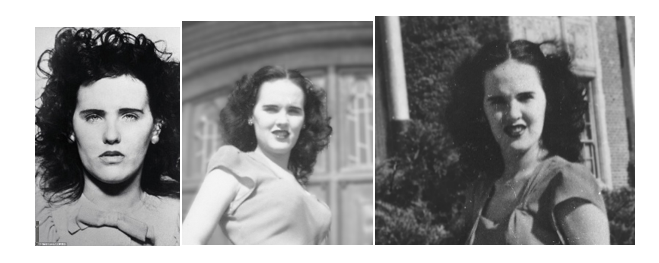
Dr. Frischholz’s findings placed the album photograph within a high similarity range (“95-97%”) relative to both reference images. While no biometric analysis can establish identity with absolute certainty—particularly when dealing with historical photographs, the results were notable, consistent, and well outside the range of casual resemblance.
Independent AI-Based Replication
More recently, an independent reader—without direction from me—applied modern AI-assisted facial comparison tools to the same question. One such reader, posting publicly under the name “Bud White,” conducted comparisons using a contemporary AI platform, restricting the analysis to facial landmarks and structural features alone.
In his first comparison—between the album photograph and Elizabeth Short’s Santa Barbara booking image—the AI reported approximately 85–90 percent facial similarity based on face shape, eye placement, nose structure, mouth, jawline, and overall cranial proportions.
Two days later, the same reader compared the album photograph with one of the John Marshall High School images. The result was even stronger: a 98–99 percent match probability, with the AI noting that the remaining uncertainty was attributable primarily to differences in lighting, resolution, and photographic noise.
This is not proof of identity. But it is far more than coincidence.
Consistency Across Time, Tools, and Analysts
What is striking is not any single result, but the convergence of results across decades, methods, and analysts.
Early biometric analysis (Frischholz)
Later AI-assisted analysis by independent readers
Use of the same core reference photographs
Comparable high similarity ranges
While facial recognition cannot deliver absolute certainty—especially with historical imagery—consistent results across independent tools and eras are not easily dismissed
Addressing a Persistent Criticism
One criticism frequently repeated is that a surviving family member of Elizabeth Short, (I believe it was one of her three surviving sisters) was shown a photograph and allegedly rejected it, stating that Elizabeth “never wore a flower in her hair.” This claim is vague, secondhand, and often conflated.
It should also be noted that when the album photograph was allegedly shown, the surviving sisters were in their seventies or early eighties, and more than half a century—nearly sixty years—had passed since any of them had last seen Elizabeth Short in person.
I have previously identified and publicly eliminated a different photograph—one depicting actress Marya Marco—that I had included in my 2003 Black Dahlia Avenger book as a possible second Elizabeth Short photograph. Follow-up in 2006, led to my identification and elimination of this second photograph, which I eliminated on national television (CNN’s Anderson Cooper 360) in 2006, nearly twenty years ago. That image does show a woman wearing flowers in her hair, and it is likely the source of the confusion, and if photographs were shown to the sister, she may well have been referring to the Marya Marco photograph, “with the flowers in her hair”, which she correctly would have eliminated as not being her sister, Elizabeth Short.

George Hodel Jane Doe #2 eliminated by author in 2006 on national tv.
 Author identified photo as Marya Marco, actress/friend of Dr. George Hodel in 2006, and in a personal interview with Ms. Marco, I identified and eliminated her photo in 2006, shown above on the television news program—Anderson-Cooper 360 that same year.
 Author identified photo as Marya Marco, actress/friend of Dr. George Hodel in 2006, and in a personal interview with Ms. Marco, I identified and eliminated her photo in 2006, shown above on the television news program—Anderson-Cooper 360 that same year.
Actress Marya Marco 1946 and 2006 with author.
Photos top left and bottom taken by Dr. George Hill Hodel
at our Sowden/Franklin House in 1946.
More importantly, the album photograph at issue here is not the eliminated Marya Marco image. That distinction was cleared long ago.
I am not here claiming my father’s album photograph definitively depicts Elizabeth Short.
What I am claiming is:
What can reasonably be said is this: the photograph cannot be casually dismissed; facial-comparison tools repeatedly place it within the highest similarity range (95–99 percent); analyses conducted nearly two decades apart align closely; and exclusion, if asserted, requires more than opinion.
In independent testing by the National Institute of Standards and Technology (NIST), facial-recognition similarity scores above the mid-90 percent range are considered high-confidence results — and they are not common, especially when comparing different photographs taken years apart. In forensic use, a result exceeding 95 percent doesn’t close the case, but it does demand serious attention. It indicates strong similarity, while still stopping short of absolute identification.
Other physical consistencies—including jewelry details—have been discussed elsewhere, but they are not examined here. The focus of this article is facial comparison evidence alone.
When facial-recognition tools—applied independently and decades apart—consistently return similarity scores approaching the upper limits of reliability, outright dismissal becomes less a scientific judgment than a personal one.
I should add that, based on the totality of circumstantial evidence developed over many years—some of which lies beyond the scope of this article—it is my professional opinion that the album photograph depicts Elizabeth Short. The purpose of this article, however, is narrower: to examine whether the photograph can be responsibly excluded in light of the facial-comparison evidence.
I’ve relied on science. Interpretation, appropriately, remains with the reader.
Very interesting analysis and I agree totally. Not a positive
proof but certainly can’t be ruled out. When I saw that photo years ago, I wondered why it was ruled out that it could not be Elizabeth Smart!? I thought “Could Be.”
Thank you for this new information, Steve!!!
Carol K: Elizabeth Short, not Smart. Frequently, mistaken names. Never “ruled out” just naysayers said, “No way” and as mentioned in the article the sister potential confusion and likely shown the Marya photo re. “She never had flowers in her hair.” Best, Steve
Given the preponderance of evidence in favour of identifying the photo as Elizabeth Short, any judge sitting on the case would likely accept the prosecution’s contention that the photo is of the victim and admit it into evidence during any trial against GHH. The testimony from various independent expert sources over the space of 12 years would be sufficient to allow positive identification.
In other words, “case closed”.
Keep up the great work. Your research is impeccable and deserves to be used as an example of how to do it well in detection and law enforcement courses everywhere.
I think what makes it a bit challenging to fully say, “that’s Elizabeth Short”, is the exaggerated lipstick that was applied. Clearly GHH wanted her lips to look like those in Man Ray’s “The Lovers” painting (or am I thinking of a Duchamp piece?). To me, that is E.S. And I like Steve’s theory that she’s leaning on the back of a chair that GHH had in his living room or study.
I don’t need to know definitively whether this is or is not a photo of Elizabeth Short. The photo did its job in helping launch Steve’s journey to the truth of the serial killer GHH. If one believes in the hand of fate, then Steve was supposed to believe it was her, regardless. Rise in Glory Elizabeth.
If symbolism & art with riddles were so important, isn´t then the big question what it meant.